Black and White

It’s funny how the riddles and jokes we thought was so funny as a kid are still just as funny to our kids, and grandkids. Emily asked “what’s black and white and red all over?” on one of her recent visits. I guessed a newspaper, but the answer was a zebra with a sunburn. She thought that was pretty funny, so I thought I’d get a little deeper into the subject with her and I asked her whether zebras were white with black stripes or black with white stripes. Actually, all I got was a slightly puzzled look and the subject moved on to something more important….
But that question does have a (real) answer, and at the risk of spoiling any fun you might have speculating — zebras are black with white stripes. 

All of a zebra’s fur, both black and white, grows from follicles that contain melanocyte cells. (Melanin is a dark pigment primarily responsible for skin color. Darker skin tones tones have more melanosomes present than lighter skin tones. Functionally, melanin serves as protection against UV radiation.) These cells are are present in all animals, and they’re primarily responsible for generating the pigment that gives color to skin and hair. Melanocyte cells produce melanin — the pigment — that is outwardly visible. In zebras, chemical messengers determine which melanocytes deliver pigment to which section of fur and creates the zebra’s black and white pattern. It’s interesting that the white fur on a zebra represents an absence of melanin….therefore, black is the “default” color of a zebra. If you shaved all the fur off a zebra, there would be no stripes — it would be an all-black animal. 

So there you have it! Maybe a more interesting question is why do zebras have stripes at all? Turns out that that’s a much harder question — no one is really sure.

There seems to be dozens of theories as to why they have stripes… one theory that’s kind of interesting is that stripes provide protection from biting flies. A recent study found that striping on animals is more common in areas rife with biting flies — that may mean that biting flies struggle to see a striped or black-and-white surface as a safe place to land.

Another interesting theory is that of thermoregulation whose argument is based on the fact that black stripes absorb heat to warm zebras in the morning chill and white stripes reflect the sun to cool zebras in the afternoon heat. 

So we do know what color a zebra is, but we don’t know why they have stripes. I read an article that suggested using zebras as a metaphor for racial harmony. Actually, that sounds like a good idea to me — after all, black or white, the footprints left in the dirt are the same….
— 30 —

Posted in Uncategorized | Leave a comment

A Record To Be Broken

I’m getting really tired of reading, and hearing, about the arguments in Congress. It sure seems as if all of the disagreements are based on “what’s best for me, or my party, the country be damned.” 

You’ve probably gathered from reading this blog, that my opinion of our elected officials has continued to deteriorate over the years and is currently at an all time low. I don’t ever remember issues that are important to our country and citizens becoming “all about me” until relatively recently. 

During my working years, I spent some amount of time in meetings with various Senate committees. A high percentage of these committee members were more interested in just getting their name in the record rather than working the problems/issues. A few were always present in order to “break the record” for attendance by their predecessors. 
Actually, Senate members have always  taken some satisfaction from setting records — just like baseball or football players. This brings me to my topic for the day….

One Senator, back in 1859, established a record that hasn’t been broken to this day — and very possibly will never be broken.
California Senator David Broderick, in September of 1859, became the only sitting senator to die in a duel. 

Broderick was born in Washington, D.C. in 1820 — the son of a stonemason who worked on the Capitol. His family later moved to New York City, where he worked as a stonemason and a saloon keeper. He was an avid reader and became a shrewd student of human nature, and observed the super heated political culture of New York City’s ward politics. 
He joined the 1849 gold rush to California and settled in San Francisco, where he quickly made a fortune in real estate. He was elected to the California  state senate, where he became a power broker within the Democratic Party’s antislavery wing and set his eyes on a seat in the U.S Senate.

During the campaign for the Senate, California chief justice David Terry denounced Broderick as no longer a true Democrat. In Terry’s opinion, Broderick was following the “wrong Douglas.” (He had abandoned Democratic Party leader Stephen Douglas in favor of “black Republican” leader Frederick Douglass.) Broderick angrily responded that Terry was a dishonest judge and a “miserable wretch.” Because of these words, Terry challenged Broderick to a duel.

The two met early on the morning of September 13 at Lake Merced, south of San Francisco. Broderick’s pistol discharged prematurely — and Terry cooly aimed and fired into Broderick’s chest. The senator’s death three days later established Broderick as a rough-and-tumble political operator with a martyr’s crown, and accelerated the downward spiral to civil war. David Terry was acquitted of the crime and went on to serve the Confederacy. Years later, in 1869, Terry was gunned down after threatening the life of Supreme Court Justice Stephen Field.
— 30 —

Posted in Uncategorized | Leave a comment

Face Cards

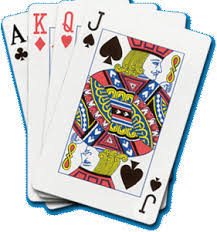
A while back, I mentioned here that I enjoyed playing games with our grandkids. Most of the card games we play use unique decks for a particular game, like Uno, Crazy 8, etc. But sometimes we play card games using a standard deck of cards. One of the times I was playing with Emily, she made the comment that “face” cards (I think she called them “picture” cards) were really ugly. 
I told her that the “pictures” were drawings of real people — she was more skeptical than impressed and of course when she asked who, she wasn’t familiar with any of the names, so she probably just put  the information in the category of another one of Poppi’s tales.

But supposedly the face cards do represent real people. Playing cards were introduced in Europe in the early 1400s and face cards were initially composed of only Kings, Knights and “knaves” (now known as Jacks.) It wasn’t until around 1440 that Queens made their introduction — first in Germany. 

Anyhow, there’s not total agreement, but most people in the know about these things believe today’s face cards depict these people:
King of Spades — David (from the Bible, the King of Israel)
King of Clubs — Alexander the Great (King of Macedonia)
King of Diamonds — Julius Caesar (dictator of the Roman Republic)
King of Hearts — Charles the 1st (King and Holy Roman Emperor of Italy)
Queen of Spades — Pallas Athena (In Greek mythology, Athena was the goddess of wisdom, courage, inspiration, civilization, law and justice, just warfare, mathematics, strength, strategy, arts and skill — whew!!)
Queen of Clubs —  Argine or Argea (One theory is that Argine is an anagram for “regina,” latin for “Queen.” Others think the Queen of Clubs  represents Argea, the mythological mother of Argus)
Queen of Diamonds — Rachel (Another biblical figure, Rachel was the mother of both Benjamin and Joseph)
Queen of Hearts — Judith (the fictional heroine of The Book of Judith, from the Old Testament of the Eastern Orthodox Bible.)
Jack of Spades — Ogier the Dane (the son of the King of Denmark in 8th century.)
Jack of Clubs — Judas Maccabeus or Lancelot (A never settled debate)
(Judas Maccabeus was a Jewish priest that is acclaimed as one of the greatest warriors in Jewish history. Sir Lancelot of the “knights of the Roundtable” and the most trusted of King Arthur’s knights.)
Jack of Diamonds — Hector (A Trojan prince in Greek mythology, the greatest fighter for Troy in the Trojan War.)
Jack of Hearts — La Hire (Étienne de Vigolies, called La Hire was a French military commander during the Hundred Years’ War.)

If you’re wondering why these people were chosen, it probably comes from the early origins of playing cards. The face cards we see today were developed in 16th century France when they pretty much took over the production of playing cards.

But no matter who, or even if, the face cards represent real people, playing cards have had some amount of influence in all our lives — we can’t change the cards we are dealt, it’s just how we play the hand. I remember my uncle used to say, trust everybody, but cut the cards…..
— 30 —

Posted in Uncategorized | Leave a comment

The Swoosh

I was given some golf balls last year — I never got around to opening the bag they were in before the weather got cold. A couple of days ago, in anticipation of good golfing weather, I decided to put them I’m my golf bag. Turns out they were Nike golf balls. They didn’t have any name on them, but I knew they were Nike because they had a “swoosh” on them. The Nike emblem is so well known that some of their products and advertisements omit the Nike name altogether and just use the logo.

Nike is  a United States corporation with headquarters in Washington County in Oregon. The company was founded in 1964 by Phil Knight and Bill Bowerman and was initially known as Blue Ribbon Sports but switched to the present Nike name in 1971. 
The Nike Swoosh is one of the most recognizable logos in the world. I figured that the company paid some major advertising firm big bucks to come up with the design. But that’s not the case.

In 1969, Phil Knight, one of the co-founders of Nike was an assistant professor at Portland State University. One of the students, studying graphic design at PSU, was Carolyn Davidson. Knight knew Davidson was in search of extra funds because she wanted to take oil painting classes, so he asked her to help him out on some projects — at the rate of $2.00 an hour. Shortly afterwards, Knight came up with the idea to strike out on his own and create his own brand of athletic shoes. He asked Davidson, as a side job, to help him come up with a stripe — or an image that could go on the side of the shoe.

Davidson came up with the Nike Swoosh — a check mark shape that was fluid and indicated movement and speed. The image also resembled a wing and helped the company decide on the brand name Nike, named after the Greek goddess of victory. After some fine tuning work on the logo, Davidson handed the design over to Knight… her charge? $35.00.

Davidson continued to design for Nike until 1975. But when she graduated from school, she decided to be a work from home freelance designer — something she continued to do for about 30 years. 

Davidson indicated that she didn’t know how long she worked on the Nike Swoosh, but she only charged Knight for 17 ½ hours of work — which amounted to the $35.00 paycheck.
Even though she was paid only $35, she was honored by the company when they threw a party in her honor — and — she was also given a generous amount of stock in the company, along with a diamond and gold ring featuring the Swoosh design. 

Over the years, Nike has come up with some great slogans to inspire people to do their best… I remember one that probably fits the bill for Carolyn Davidson — “Start unknown. Finish unforgettable.”
— 30 —

Posted in Uncategorized | Leave a comment

Earth Day — 2022

Today (April 22) is Earth Day — a day when humans everywhere take a minute to be grateful for our planet and the amazing natural resources we’ve enjoyed…. at least so far.

Earth Day was started in 1970 by Wisconsin Senator Gaylord Nelson. Senator Nelson was concerned that environmental issues were not being addressed in the political arena, especially after he witnessed the aftermath of an oil spill in California in 1969. He was inspired by Vietnam War protests to organized a nationwide grassroots demonstration to promote conservation awareness and involvement. 
Nelson set his demonstration for April 22, 2970. He chose the date to fall between spring break and final exams in the hope that college students would participate. About 20 million Americans showed their support and it soon became the first official “Earth Day.”

Believe it or not, both republicans and democrats (in 1970) responded to the environmental conservation messages of Earth Day. The movement helped inspire the United States Environmental Protection Agency (EPA,) as well as the Clean Air, Clean Water, and Endangered Species acts.

The campaign spread internationally and by 1990, 200 million people mobilized in 141 countries.
Today, people in more than 190 countries will participate with rallies, concerts, acts of service, and outdoor activities. One of the most popular Earth Day songs, Earth Anthem, was written in 2013 by Indian poet Abhay Kumar — it has been translated and recorded in all official UN languages.

This year we’re celebrating the 52nd Earth Day with the theme “Invest in Our Planet.” We all need to take an active part in saving out planet and figuring out new ways to do it. Socrates said, the secret of change is to focus all of your energy not on fighting the old, but on building the new. 

However you choose to honor it, Earth Day is a great way to jumpstart a lifetime dedication to taking better care of our planet.

— 30 —

Posted in Uncategorized | Leave a comment

Colonel Lee

A few days ago I blogged about Colonel Lee’s Mongolian BBQ — one of my all time favorite places from my past. It turns out that there really was a Colonel Lee and he really was a colonel — in Taiwan’s Republic of China army. 

I actually met Colonel Lee… during one of my many nights at Colonel Lee’s in Mountain View, he came into his restaurant that was located on Castro Street. I’m pretty sure he lived in the Los Angeles area at the time. The manager/owner of the Mountain View restaurant brought Colonel Lee over to our table and he sat down with us for a few minutes — maybe because he was told that I was their best customer…. even though I lived in Virginia. 

As I said, Colonel Lee, who was introduced to me as “John,” was an actual colonel in Taiwan’s army and immigrated to the U.S. in 1966. I remember having a very nice conversation and told everyone the next day that I had met the real Colonel Lee. No one was as impressed as I was.
— 30 —

Posted in Uncategorized | Leave a comment

Cheers

Happy Easter! This year, in addition to Easter, the 17th of April is World Malbec Day. World Malbec Day is celebrated every year on this date… this year it happens to coincide with Easter

World Malbec Day is an initiative promoted by “Wines of Argentina,” and was started in 2011. It is supported by several Argentine government departments. 
On April 17, 1853, local officials in the Mendoza province approved the region’s first agronomy school, Quinta Normal and Agricultural School, which would study grapes for agricultural purposes. This is the reason this date was chosen by the “Wines of Argentina” organization as the day for World Malbec Day.

The Malbec grape is actually French in origin, but most Malbec today comes from Argentina — how come?

A french agricultural specialist, Michel Aimé Pouget, was teaching agricultural knowledge at the Qinta Normal de Santiago Institute in Chile in the 1840s. The institute imported various agricultural products, including grape vines, from France, to try growing in Chile. It’s believed that likely the Malbec grape arrived this way in Chile in the mid 1840s.

An Argentine man named Domingo Faustino Sarmiento was in exile in Chile at the time. An intellectual, activist, and writer, he took an interest in the agricultural institute. When he returned to Argentina, he proposed that a similar agricultural institute should be established in Argentina. A local government in the Mendoza region approved the establishment of the Quinta Normal and Agricultural School on the 17th of April, 1853. Authorities persuaded Michel Aimé Pouget to make the move from Chile to Argentina to get the new school set up and run it. Among other activities, it would study and promote grapes for wine in Argentina. The Malbec cuttings probably arrived with Pouget from Chile.

The Malbec grape did very well in Argentina — even better than it did in Chile, or France. And — as luck would have it, it was brought to Chile and Argentina just in time, because in 1863, the phylloxera plague hit France, destroying grape vines there. 
Domingo Faustino Sarmiento went on to become president of Argentina from 1868 to 1874.
Seventy-five percent of the Malbec wine in the world comes from Argentina.
In Argentina, the three main growing regions are San Juan, Salta, and Mendoza, with Mendoza being the largest region by far — being home to 85 percent of Argentina’s Malbec plantings. 

In France, the grape is known by the name of “cot,” and is cultivated in Cahors in the south-west of the country, and in the Loire. If a French wine says “Cahors” on the label, it is made from Malbec grapes. 
— 30 —

Posted in Uncategorized | Leave a comment

Easter —2022

Today is Easter, celebrating Jesus’s resurrection — the foundation upon which Christianity was built. It’s obviously one of the most important Christian holy days, and like most special days, it has its traditions, symbols and customs.

Many historians believe that Christians named Easter after Eastre or Eostre, a pagan Anglo-Saxon goddess, in the hopes of encouraging conversion. The early Christians called their Easter celebration “Eosturmonath” after the (Germanic) goddess Eostre. She was recognized as the bringer of springtime and flowers, and after all the celebrations in her honor, the name stuck around for the Christian celebration of the Resurrection.

The early Christians had to link up with something that was relevant and familiar in order to help their new religion get off the ground, so using familiar symbols helped to move their ministry forward and also provided a helpful tool for what they were trying to say. Both rabbits and eggs were pagan symbols of fertility and new life. Over time, eggs gained the representation of Jesus’ emergence from the tomb. In the middle ages, it was forbidden to eat eggs during Lent, so once Easter arrived, the egg shells were painted to celebrate the end of this period and that Christ rose from the dead.

The legend of an egg-laying, candy-giving bunny rabbit was born in Germany and the tradition didn’t arrive in the United States until the first Germans immigrated to America in the 1700s.

Obviously we’re all thinking about Ukraine this year, but while the tradition of dyeing eggs at Easter began as a religious practice, the custom of decorating those eggs comes from a Ukrainian craft dating back thousand of years. The eggs, called pysankas, are created using wax and dyes, a process Ukrainian immigrants brought with them to the United States. 

A co-worker of mine used to say that Orthodox Easter was later because then you get stuff cheaper, but Easter, and Orthodox Easter, is meant to be a symbol of hope, renewal and new life — Happy Easter.
— 30 —

Posted in Uncategorized | Leave a comment

Good Friday

Today, April 15 this year, is Good Friday. The day is observed as an occasion for fasting, reflection, prayer and solemnity by most Christians and Catholics.

The date of Good Friday shifts from year to year — it all comes down to the lunar calendar, specifically the first full moon to take place after the spring equinox — Good Friday is celebrated the following Friday.

Superstitions say that buns baked on Good Friday will never spoil, protect against shipwrecks and will even shield your home from fire. Another old legend says that people who share a hot cross bun will remain good friends for a year — if — they say a special rhyme while enjoying the bun: “Half for you and half for me, between us two shall goodwill be.” Might be worth a try….
Another superstition encourages you to get a haircut on Good Friday — it prevents headaches for the rest of the year (and makes you look nice for Easter.)
Every year, the open-air play “The Passion of Jesus” is performed in London’s Trafalgar Square — for free. It’s even streamed live on Facebook.

Jamaica has a strange custom — before sunrise, you crack an egg and add just the egg white to a glass of water. As the rising sun heats the egg, patterns form in the glass. Elders believe the way the white swirls can predict the way in which you will die.
The Irish have a tradition of marking eggs with a holy cross and having each family member eat one on Easter Sunday — doing this will help bring good health and luck in the next year. They also believe that eggs laid on Good Friday will never rot — some people hold onto eggs for decades just to prove the myth.

In the Philippines, they re-enact the Crucifixion by actually nailing people (they are volunteers.)
Every year on Good Friday, Bermuda holds its famous kitefest. People go to the beach for a day of easter egg hunts, Bermudian food and kite flying.

When Pope Benedict XVI visited Cuba in 2012, he requested that the Cuban government make Good Friday an official holiday, allowing people to stay home and observe the sacred day without taking off work — his request was granted.
In New Zealand, TV and radio ads are prohibited between 6 a.m. and noon on Good Friday, out of respect for the religious day of observance.
In Germany, this day is called Sorrowful Friday and dancing is prohibited, forcing nightclubs to close or risk being fined. 
The very first Good Friday was observed on Friday, April 3, A.D. 33.

On Good Friday in 1930, BBC radio announced, “There is no news.” The station then played piano music for the rest of the day. I’m pretty sure that’s not likely to happen this year.
— 30 —

Posted in Uncategorized | Leave a comment

No Longer Fishy

When our daughter, Kelly, was little, she wouldn’t eat anything if it didn’t have ketchup on it. For years, a friend of ours always gave Kelly something for Christmas or her birthday that was in some way related to ketchup. 

I guess when I think of ketchup, I think of Heinz, and Pittsburg and the Steelers and the “red zone.”
Pittsburg is the headquarters of H.J. Heinz Company that was founded about 125 years ago. I’ve heard it said that Pennsylvania is where ketchup was invented (and by Herr Heinz.)
But — my extensive research says that’s not so — It’s not even close…. well, actually Pennsylvania does get the credit for tomato ketchup, but now I’m spoiling the story….

I hope you’re ready for this — the ancestor of modern ketchup was completely tomato-free. Actually, the precursor to what we call ketchup was a fermented fish sauce from (where else?) China!. As far back as 300 B.C., texts began documenting the use of fermented pastes made from fish intestines, meat byproducts and soybeans. The fish sauce — called “ge-thcup” of “koe-cheup” by speakers of the Southern Chinese Min dialect, was easy to store on long ocean voyages.
The pastes or sauces spread along the trade routes to Indonesia and the Philippines, where British traders, in particular, developed a taste for the salty condiment. They took samples home and promptly corrupted the original recipe.

During the 18th century, cookbooks featured recipes for ketchups made of oysters, mussels, mushrooms, walnuts, lemons, celery and even fruits like plums and peaches. Usually, the ingredients were either boiled down into a syrup—like consistency or left to sit with salt for extended periods of time. Both these processes led to a highly concentrated end product — with a salty, spicy flavor that could last for a long time without going bad.

Finally, in 1812, the first recipe for tomato-based ketchup was invented. James Mease, a Philadelphia scientist, is credited with developing the recipe. He wrote that the choicest ketchup came from “love apples.” That was what tomatoes used to be called — some believed they had aphrodisiac powers.

Before vinegar became a standard ingredient, preservation of tomato-based sauces was an issue, as the fruits would quickly decompose. A relatively new company called Heinz introduced its famous formulation in 1876, which contained tomatoes, distilled vinegar, brown sugar, salt and various spices. They also pioneered the use of glass bottles, so customers could see what they were buying.
Tomato-based ketchup slowly became the ubiquitous form of the condiment in the U.S. and Europe. Today Heinz is the best selling brand of ketchup in the United States.

Jeff Foxworthy said you might be a redneck if your only condiment on the dining room table is the economy size bottle of ketchup — but if it is, you can be sure it’s bright red and made with tomatoes.
— 30 —

Posted in Uncategorized | Leave a comment