Lobbyists

Some friends of ours live next to a property owned by the Willard family — of the Willard Hotel in Washington, D.C. The other day while watching the news, there was a segment on lobbyists and the conversation got around to the term “lobbyist” originating in the Willard Hotel. Claire said that the term’s origin was a well known fact…. well, the “fact” is that I’d never heard it before. But without giving it much thought, it seemed to make some amount of sense to me.
But — I thought maybe I should do a little extensive research and check it out.

The term “lobbyist” in common political speak is someone who solicits the attention of an elected official or government agency in the hope of receiving preferential treatment in legislation, or regulations.

Anyhow, I found plenty of material to support what Claire said — the most popular story is that President Ulysses S. Grant would frequent the Willard Hotel to enjoy brandy and a cigar, and while he was there, he’d be hounded by petitioners asking for legislative favors or jobs. It is said that President Grant coined the term by referring to the petitioners as “those damn lobbyists.” The story has been told and published by the Washington Post, the American Society of News Editors, and most often by the Public Relations Director of the Willard Hotel. 

It is kind of a fun story and I’m sure it’s done a lot to increase visitors and revenue for the Willard Hotel. But — the story isn’t really true. President Grand did visit the Willard Hotel and enjoyed his brandy and a cigar, but he did not coin the term “lobbyist.”

The term “to lobby” first appeared in print in the United States in the 1830s. President Grant was in office from 1869-1877.
The term is believed to have originated in the British Parliament and referred to the lobbies outside the chambers where a lot of wheeling and dealing took place. “Lobbyist” was in common use in Britain in the 1840s. The Oxford English Dictionary indicates that the term was used as early as 1640 in England to describe the lobbies that were open to constituents to interact with their representatives. 

Once again, extensive research ruins a really good story. But that’s one of the good things about history — it’s full of so many stories to tell, some of which take on a life of their own, even if the facts don’t necessarily back them up.
— 30 —

Posted in Uncategorized | Leave a comment

Dancing Machines

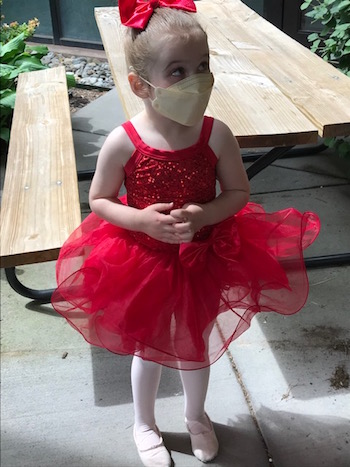
This was dance weekend for us. Turns out that all our granddaughters are turning into dancing machines. Emily has been at it for a few years now, and Ellie and Rory just started fairly recently, but they seem to be coming along.

I didn’t get a picture of both Rory and Ellie, but they were dressed exactly alike, and the look exactly alike. So the picture is of Ellie, or maybe Rory… I suppose I could have just printed it twice and not said anything — probably no one would know…. except Locke.
— 30 —

Posted in Uncategorized | Leave a comment

A Moon Lit Night

A number of members of our family are convinced that a full Moon affects people’s behavior. I have to admit that over the years, I’ve witnessed some strange behaviors during full Moons — probably too many to be coincidental, so maybe there’s something to it….

Anyhow, this month’s full Moon is special in a few ways — it reaches its peak illumination early tomorrow morning at 12:15 a.m., May 16. So tonight, weather permitting, you should get a really good view. 

This will be the first supermoon of the year — there will be three more in 2022. A supermoon is defined as any full Moon that occurs when the Moon is at least 90% of perigee (the point in the Moon’s orbit that is closest to Earth.)
And — May’s full Moon coincides with a total lunar eclipse. A lunar eclipse occurs when the Earth comes directly between the Moon and the Sun, which results in the Earth casting its shadow on the Moon. During a total lunar eclipse, the Moon is fully obscured by Earth’s shadow, giving the Moon a reddish hue. This phenomenon is where the term “blood moon” comes from.
Depending on the weather, we should be able to see the eclipse here in Shepherdstown. The maximum, or peak, eclipse should occur at 12:11 a.m.

Full Moons are often given names and these names come from (usually) Native American, Colonial American, and European sources. Traditionally, each full Moon name was applied to the entire lunar month in which it occurred, not just to the full Moon..
This month’s name is the Flower Moon. The name has been attributed to Algonquin peoples and the name isn’t particularly surprising given that flowers spring forth in abundance this month….

The name “moon” is derived from the Latin word luna and it’s the Earth’s only permanent natural satellite, and it is in synchronous rotation with the Earth — that’s the reason we can only see one side of the Moon. Even though the Moon appears white, it’s just reflecting the light from the sun…. its surface is actually dark.

So the Moon is really pretty cool — on nice rights, it’s always fascinating to watch the Moon — it’s always gong through various phases — just like we all do….
— 30 —

Posted in Uncategorized | Leave a comment

Not Just For Sweeping

We had a discussion during our last “winter golf” session that always amazes me. A lot of people that I know are not aware that brooms (before plastic came along) were made from corn — specifically, broomcorn. (You can read about broomcorn in a number of places in this blog — search the archives if you’re interested.) Anyhow, explaining broomcorn to people always produces an interesting dialogue.

But “regular” corn is a pretty interesting subject, too. For instance, did you know that corn always has an even number of rows on each ear? Here’s the “scientific” explanation as to why…. An ear of corn is actually an inflorescence (the complete flower head of a plant) that produces nearly 1,000 female flowers. These flowers, or potential kernels, are arranged in an even number of rows (usually from 8 to about 22 rows.) The number of rows is always an even number because corn spikelets are borne in pairs, and each spikelet produces two florets: one fertile and one sterile. Stress at a particular stage in development could theoretically produce an ear with an odd number of rows, but if you look under a microscope, you’ll probably find an unseen row that failed to develop fully. 
The average ear of corn has 800 kernels, arranged in 16 rows.

Many years ago, finding odd-rowed ears of corn was sometimes used to make impossible-to-come-true promises. For instance, slaves might be told that they could have their freedom if they could find an ear of corn with an odd number of rows. 

There’s a story told of a slave who, on being promised his freedom if he could find an ear of corn having an odd number of rows or kernels, went into the corn field and carefully opened the husks on a number of ears and deftly cut out a row kernels from each, closing up the husks over the ears again. The corn grew and ripened, closing up in its growth the vacant spaces, and when it was gathered he found an ear with an odd number of rows, and presented it and claimed his promised freedom.

If you’re ever in South Dakota, you should stop by Mitchell, South Dakota — home of the world’s only Corn Palace. It was built 1892 to display the products of the harvest of South Dakota’s farmers — in murals on the outside of the building. The murals are made from thousands of bushels of corn and other gains and grasses such as wild oats, rye, straw, and wheat. Each year the corn decorations are completely stripped down and entirely new murals are created. 

Corn is the 3rd most important crop of the world measured by production volume, behind wheat and rice. In terms of acreage planted, it is second only to wheat. 
Corn is used in the production of alcohol, and distilled spirits, corn syrup, sugar, cornstarch, synthetic fibers such as nylon, certain plastics, in the manufacture of wood resin, lubricating oils and synthetic rubber, as an abrasive, corn cob pipes, corn oil, margarine, saccharine, paints, soaps, linoleum and gasohol. It’s an ingredient in more than 3,500 grocery products.

So if you’re not like me, growing up thinking corn was just something brooms were made of, you realize the importance of corn in our lives…. it was discovered by Indians, is distributed by farmers, distilled by moonshiners, and dispensed by comedians.
— 30 —

Posted in Uncategorized | Leave a comment

Slow Down

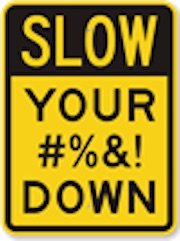
We live in an area with a lot of mountains and the roads are mostly two-lanes and have a lot of curves. As you might expect, a lot of the speed limits in our area are less than 55 mph. I’ve noticed lately, that a lot of people are driving quite a bit faster than the posted limits. Also a lot of people don’t seem to know that the yellow line down the middle of the road is not meant to be driven on, but to help you stay on your side of the road… but don’t get me started on that irritation.

Anyhow, whether you appreciate them or hate them, speed limits are important and their intent is to make the roads safer for everyone.

I grew up in Oklahoma and (at the time) it was mostly “open spaces” and the roads were straight and people drove fast. Also, there weren’t that many cars on the road in those days. But since the early days of cars, there has been a debate about freedom versus regulation in regards to speed limits. Some states, like Montana and Nevada, have historically opposed restrictive speed limit laws and imposed minimal fines for noncompliance. 

Connecticut was the first state to pass a speed limit law — in 1901. That law limited the legal speed of motor vehicles to 12 mph in cities and 15 mph on country roads. But speed was a concern even before the invention of motorized vehicles. The colony of New Amsterdam (now New York) issued a law in 1652 stating that wagons, carts and sleighs cannot be run, rode or driven at a gallop. Violators of that law faced a penalty that started at two pounds Flemish — about $150 by today’s standards.

New York City introduced the world’s first comprehensive traffic code in 1903. But the adoption of speed regulations, and other traffic codes, was a slow and uneven process across the nation. As late as 1930, a dozen states had no speed limit and 28 states didn’t even require a driver’s license to operate a motor vehicle. 

Rising fuel prices contributed to the lowering of speed limits in some states in the early 1970s and in 1974, President Richard Nixon signed a national speed limit of 55 mph into law. These reduced speed limits led to a reduction in the nation’s traffic fatality rate.
Concerns about fuel availability and cost subsided after a while and in 1987 Congress allowed states to increase speed limits on rural Interstates to 65 mph. The National Highway System Designation Act of 1995 repealed the maximum speed limit. That returned control of setting speed limits to the states. Since then, 35 states have increased their limits to 70 mph or higher. Today there is only one country in the world which has no speed limits at all — the Isle of Man. Between 1995 and 1999 Montana had a “reasonable and prudent” speed limit which was non-numerical.

So like it or not, speed limits are here to stay, and none of them are going to please everyone. Some are advocates of the “speed has never killed anyone. Suddenly becoming stationary, that’s what gets you” school of thought….
— 30 —

Posted in Uncategorized | Leave a comment

IX.V.MCMLXXVI

If you’re not good at Roman Numerals, the title of this blog is the 9th of May, 1976 — the day our baby daughter was born. It was a Sunday, in fact it was Mother’s Day. 

If we had saved the calendar from the year Kelly was born, we’d be able to use it again, but not until 2032. The 1976 and 2032 calendars would be exactly the same — well, that’s not totally true, some days like Easter and other irregular holidays that are based on a lunisolar calendar, wouldn’t match up.

I tried to figure out how old Kelly would be in dog years, but even though I always thought one dog year equaled 7 human years, my extensive research found out it was more complicated than that… dogs age differently depending on breed and size — you you have to pick a specific dog or breed. If you pick a Swedish Vallhund (say his name is Sampson,) he would be 220 dog years old. When Kelly reached the age of 6, Sampson would have been 42 dog years old From that point forward a medium-sized dog like Sampson will age 4.5 dog years for every human year.

Kelly’s birthday numbers 5, 9, and 1976 makes her Life Path number 1. It represents initiative, potential and singularity. She is a born leader, and insists on her right to make up her own mind — and — demands freedom of thought and action. 
Who wouldn’t be proud of a daughter like that?
Happy Birthday Kelly!!
— 30 —

Posted in Uncategorized | Leave a comment

Mother’s Day — 2022

Today is Mother’s Day — a day that gives people a special opportunity to show their gratitude to the moms, grandmas, stepmoms, aunts, and other maternal figures in their lives. Mother’s Day is always the second Sunday in May — this year, that’s May 8.

The average age for first time mothers has gone up over the past 20 years… in 2000, the average age was 24.9 years, in 2020 it was 27.1 years old.

Mother’s Day always falls on a Sunday, and attending church is a popular activity among families. A recent poll asking pastors about the highest attended Sundays at their churches throughout the year, Mother’s Day ranked third behind Easter and Christmas.

Today has always been a day to take mom out to dinner — even during the pandemic. In 2020, consumer spending at restaurants increased 103 percent on Mother’s Day Sunday (compared to the average daily revenue throughout the pandemic. 

Some data indicates that the Greeks and Romans celebrated Mother’s day by honoring goddess Cybele, personifying Mother Earth (Gaia) and the goddess of fertility, and Rhea, mother of the gods.

The idea of Mother’s Day first surfaced in the United States after the Civil War and was suggested by social activist Julia Ward Howe. However, her vision was a Mother’s Day for Peace — where women would protest against war. 

The current version of Mother’s Day was started by Anna Jarvis in the early 1900s. Jarvis persuaded President Woodrow Wilson to declare that the second Sunday of every May would be Mother’s Day. But less than 10 years after she fought so hard to make it happen, Anna Jarvis despised the holiday and spoke out vehemently about the commercialization of Mother’s Day, and called for its demise. She was actually arrested during one of her protests in 1948.

They say a woman’s work is never done — that’s especially true for moms… it’s a 24/7, 365-day commitment and according to research, stay-at-home-moms should earn $162,581 a year.

So the old adage that “life doesn’t come with a manual; it comes with a mother,” is probably true and we should thank her every day, but maybe especially today — Happy Mother’s Day.
— 30 —

Posted in Uncategorized | Leave a comment

The Big Five O

Well, we made it!! The big five-O — If you were at this space last year at this time, you know that I was bemoaning the fact that we’d been married for 49 years and that, according to the experts, wasn’t anything special…. it just counted as another year of being married. 

You all know that I try to provide factual information here — of course sometime i resort to “alternate facts,” but this is real data, provided by the Census Bureau. Fifty-five percent of currently married couples have been married for at least 15 years, and thirty-five percent have reached their 15th anniversary. But — only six percent have made it to their 50th wedding anniversary.

So that puts us in a pretty select group. Our lives have changed in so many ways over the past 50 years…. I’ve mentioned before, that we’re now the elders of the family. When we got married, there were no iPhones and personal computers didn’t exist and if they had, no one would have had any idea what to do with them. Nine-eleven was just the eleventh day of September, mass shootings hadn’t yet become popular. And of course, who would have imagined that we’d have to live through a pandemic to get to 50 years.

A couple of people have said to me, “gee, that’s a long time — how’d you do it?” I never thought about it being particularly difficult — we’ve been lucky, we’ve had many, many more good times than bad times. 

I gave the same advice to both Kelly and David when they got married. I told them that the development of a good marriage isn’t a natural process — it’s an achievement. So I guess being married for 50 years is an achievement.

I also told both kids that the key to a good marriage was to love each other for what they are, not what you want them to be. Don’t enter marriage thinking someone will change, or that you can change someone. Over the years, there are two or three things I’d like to change about Claire, and there is something more than 16,000 things she’d like to change about me. But I didn’t and she didn’t.
That enabled two un-perfect people to put together pretty close to a perfect marriage. 
I propose a toast to the best 50 years of my life!!
— 30 —

Posted in Uncategorized | 3 Comments

The Fifth of May

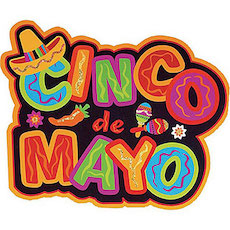
So today is the day you should probably just avoid all the Mexican restaurants — it’s Cinco de Mayo Day. We avoid restaurants on Valentine’s Day because they’e always packed, and we do the same for Mexican restaurants on Cinco de Mayo Day for the same reason.

We always celebrate Cinco de Mayo a day or so before, or sometimes a few days after. But, as has become the custom here on this blog, this is a day to talk about this, mostly American, holiday. Maybe I can even avoid repeating the things I’ve written on May 5 in past years…..

As a bit of background, the so-called War of Reform broke out in 1858, shortly after liberals drafted a new constitution aimed at reducing the power and influence of the Catholic Church. During the conflict, Mexico had two governments — a conservative one in Mexico City led by General Félix Zuloaga and a liberal one in Veracruz led by Benito Juarez, president of the supreme court. The liberals emerged “victorious” in 1861but the country remained starkly divided, with the conservatives plotting their revenge.

After the War of Reform, Mexico had virtually no money in its treasury and owed tens of millions of dollars to foreign debtors. President Juarez suspended payment of all foreign debt for two years — a move that prompted an immediate backlash from Spain, France and Great Britain. At the time, the United States was too consumed by its own Civil War to worry about enforcing the Monroe Doctrine and troops from those three countries began arriving in Veracruz in late 1861. Spain and Great Britain almost immediately withdrew, but about 6,000 French troops pushed inland toward the capital, supported by Mexico’s vanquished conservative leaders. 

In 1862, the French had one of the best armies in the world. When they arrived at Puebla, on May 4, they were coming off a series of victories in Southeast Asia and Northern Africa and were loaded with firepower, including long-range rifles that put the Mexicans’ muskets to shame. On the morning of May 5, the French tried to intimidate the Mexicans with bugle calls and advanced bayonet maneuvers, but after a full day of fighting, including three unsuccessful uphill charges, they were forced to retreat due to heavy casualties. 

Mexico’s victory at Puebla slowed, but didn’t stop France’s assault. After the Puebla battle, Napoleon sent almost 30,000 more troops to Mexico, and they were able to overrun Puebla and easily conquer Mexico City.

President Juarez declared Cinco de Mayo a holiday immediately after the Battle of Puebla, but for many/most Mexicans, it has always taken a backseat to events like the September 16 Independence Day. But in the United States, Cinco de. Mayo gained traction during the 1960s when activists in Chicago began looking for a way to honor their history and culture.

Cinco de Mayo is mostly celebrated in Puebla, Mexico — not across the entire country…. the Battle of Puebla was a short, small battle and certainly didn’t signal winning the war. And while Mexico didn’t win the war, this small victory gave hope to people across the world fighting against larger, stronger enemies.

So today, we celebrate the Battle of Puebla — a battle that lasted only about 4 hours. Seems like a good reason for margaritas to me…..
— 30 —

Posted in Uncategorized | Leave a comment

Just The Facts

I don’t know about you but, at this point in time, I’m getting tired of hearing about the Presidential election being “stolen.” A lot of things are believed because they are obviously, or demonstrably true. But some things are believed because they are consistent with some broadly held vision of a number of people — and this vision is accepted as a substitute for the facts.

Someone once said, “Never underestimate the difficulty of changing false beliefs by facts.” I’m not sure who said it, but he or she was right on the money.

The problem is that false beliefs are not always just crazy ideas — they are often both plausible and logical — but there’s always something missing. Their plausibility often gains them political support. 

I read a book on economics recently that discussed fallacies and the author indicated that sometimes what is missing in a fallacy is simply a definition. I think he’s right. Particular words appear to have special powers, especially in politics, like fair, equality, social justice, etc. The fact that terms like these are undefined is a huge political advantage. These “undefined” terms can mean wholly different things to different groups or individuals but for some reason they come together in support of movements that use such appealing words.

A lot of fallacies have been around forever — there are many reasons why they have such staying power, even in the face of hard evidence against them. Elected officials can’t readily admit that they were wrong, or some policy or movement they supported turned out badly without — in their minds — risking their whole career. No one likes to admit being wrong. But sometimes the cost of not admitting to being wrong are too high to ignore.

Many beliefs that collapse under scrutiny may continue to exist indefinitely when they are not examined, and especially when skilled advocates are able to perpetuate those beliefs by forestalling scrutiny through appeals to emotions and/or interests.

Some of the fallacies we read about today in the newspapers and on the Internet are old — maybe centuries old — and were refuted long ago, but many have been repackaged in up-to-date rhetoric to suit current times.

So people are going to continue to believe what they believe, based on appealing terms, politics, old wives tales, whatever… not the facts. I predict we’re going to continue to hear about the “stolen election” for many, many years even though facts prove statistically there is enough voter fraud to sway exactly zero elections.
— 30 —

Posted in Uncategorized | Leave a comment