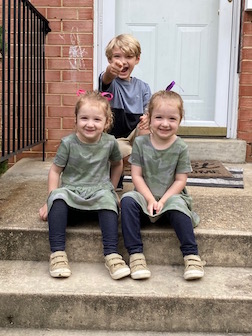
Well, I guess it’s official now — summer’s over.
All the grandkids are in school this week.
Rory and Ellie are the last to start —good luck to the teacher figuring out who is who….
— 30 —

Well, I guess it’s official now — summer’s over.
All the grandkids are in school this week.
Rory and Ellie are the last to start —good luck to the teacher figuring out who is who….
— 30 —
Today is the day to honor the ampersand — you know, that strange curly symbol that’s often used in place of the word “and” in logos and places where a person writing a sentence is trying to save some time, or is running out of space.
If you’re like most people, you probably give very little thought to this symbol and that makes it even more important that it should have its own holiday — every year, September 8 is known as National Ampersand Day.
Here’s some interesting things you may not know about this symbol most of us use often:
The symbol “&” has been around for more than 1,500 years.
The ampersand originally meant “et” or “and” in Latin.
The ampersand was actually a part of the English alphabet during the early 19th century. It was the last letter in the alphabet.
The ampersand is both a ligature and a logogram.
The ampersand is a commonly used special character for people’s passwords.
A lot of companies and brands use ampersands in their names and/or logos — such as, Ben & Jerry’s, M&M, Smith & Wesson, A&E, AT&T, and Barnes & Noble.
The symbol actually has a long and storied history….
The origin of ampersand is from the Latin Language and the alphabet position as per Latin is 27. The symbol is a logogram and began as a ligature of the letters “et,” Latin for the world “and.” The symbol goes back thousands of years but first showed up in English during the late 18th century. During the late Middle Ages, single letters that were not only letters, but could also function as a word, such as “A” and “I,” were referred to as letters by using the phrase “per se.” That phrase was used to clarify that the letter was being used in that context and not the word.
For example, if someone wanted to refer just to the letter “I” and not the word “I,” then they would say I per se, I.” This means in Latin “I by itself.” When the 27th letter of the English alphabet was added, “&” would be referred to as “& per se, and.” That meant “& per se, means and.” Eventually, that evolved into the word we now use, ampersand.
National Ampersand Day was invented by Chaz DeSimone, the founder of Amper Art in 2015. Amber Art is a website that was founded in 2011 — it showcases ampersand art posters that DeSimone has created.
So today I’m going to make sure to use an ampersand in everything I write….
— 30 —
When I was growing up, my family really didn’t have any “traditions,” at least not what I’d call traditions today. But since we’ve just celebrated Labor Day weekend, I remembered something that we did every year on that weekend — we watched the Jerry Lewis Muscular Dystrophy Association Labor Day Telethon.
I guess a lot of people tuned in every year to watch the weekend-long telethon hosted by Jerry Lewis, who served as the M.C. for all kinds of entertainment — sometimes very professional and other times not so much. And there was the constant “encouragement” for all the viewers to donate to the Muscular Dystrophy Association.
Every year, the show dominated by Jerry Lewis, delivered a mix of show business schmaltz and true-life, touching stories of people who had muscular dystrophy. Whether you liked it or not, it was live television. I remember as the hours rolled on, Lewis got alternately cranky and teary, pleading with everyone to make the donations on the tote board increase.
I don’t remember watching this telethon after I left home, but I looked it up and apparently Jerry Lewis last hosted the Muscular Dystrophy telethon in 2010 — Jerry Lewis died in 2017.
The first MDA Labor Day Telethon was broadcast on only one station — WNEW-TV in New York. According to the MDA, the telethon raised nearly $2 billion over the years.
I read an article a few years ago that indicated that before the telethon ended, people who had muscular dystrophy — a group of diseases that cause muscles to progressively weaken — and those people’s advocates objected to lewis treating those with the disease as pathetic victims.
I’m not sure if the Muscular Dystrophy Association still holds a telethon — obviously it was a good cause, but I suspect it’s one of those “things of the past,” although I have to admit it was a one-of-a-kind experience.
— 30 —
Today is thought of by many as summer’s last hurrah. Many also know it for barbecues and the unofficial cutoff for wearing white clothing — yep, today, September 6, is Labor Day. Labor Day falls on the first Monday of every September and this year that’s today.
In general, you can thank some 19th century Americans for this three-day weekend.
As we’ve discussed in past years, the true founder of Labor Day remains unknown, bur it is generally attributed to two different origins — and, it doesn’t help that people who get the credit have very similar names — Peter McGuire and Matthew Maguire. I won’t repeat what I’ve discussed in past years about Labor Day, but both McGuire and Maguire, who are not related, had the same passion for improving the working conditions of Americans.
We’ve all heard the expression, “no white after Labor Day.” This fashion “rule” says to put all your white clothes back in the closet. Of course, there are weeks of warm weather left, so why put white things away starting tomorrow?
It seems like the creators of this fashion edict were wealthy, high-society 19th century women who were upset because their social lives were being invaded by “new-money” newcomers. To separate them from brand-new millionaires in the social hierarchy, insider knowledge became a common practice to separate “old-money” from “new-money.” According to lore, the introduction of Labor Day provided a checkpoint at the end of the summer social season to single out those in the know.
Lighter fabrics reflect the sun during the hot summer months, making white a popular and practical color. Custom dictated a return to darker, heaver fabrics once cooler weather came.
In recent years, so-called respected etiquette guides say that rule is a thing of the past.
Labor Day is a time to pay tribute to American workers, and all of their many contributions and achievements through the years. Today honors the men and women who fought tirelessly for workers’ rights, especially the eight-hour work day we have now.
So as we eat our hot-dogs and have that one more beer or glass of wine, we should all take some time to reflect and pay respect to all the workers, past and present, who have made American the country it is today. Thomas Edison said there is no substitute for hard work. I’ll drink to that!
Happy Labor Day!
— 30 —


This week all our grandkids will be back in “school.”
Rory and Ellie have had their Pre-School orientation and did really well.
Won’t be long before you’ll be getting a ‘save the date’ notice for their graduation.
Wishing them a safe, fun year of pre-school…
— 30 —
Eleven years ago today this blog’s entry read in part “…. Emily weighed seven pounds (exactly) and was 21 inches long. If you divide 7 into 21 you 3 which just happens to be the date she was born (and my favorite number.) If you’re one of those people that think numbers mean something (or even if you’re not) I think the meaning here is pretty clear — this is no ordinary baby…..”
Of course today is our Number one granddaughter’s birthday. She’s a lot like me, in that shortly after our birthdays, school starts. This year Emily started to middle school…. another big step
In my first blog about her, I said that the numbers 7, 21 and 3 foretold good fortune for her — and we just keep adding more numbers. Last year we added ten (a perfect ten) and this year eleven (years) and the number six (6th grade.) All good numbers. She was no ordinary baby — and she won’t be any ordinary sixth grader!
Happy Birthday Emily!! Love You!!!
— 30 —
Yesterday, I mentioned that the month of September appeared in the title of more songs than any other month. I hadn’t thought about it, and don’t know if that’s really true, but there are quite a few “September” songs.
I do remember a song called “September” by Earth Wind & Fire. That group was popular about the same time as Blood. Sweat & Tears, and I liked both groups. Carole King was another of my favorites around that time and she had a song, “It Might as Well Rain Until September.” I don’t think it was one of her biggest hits, but I do remember it. We went to see Neal Diamond concerts and he always sang “September Morn.” So I guess there is a number of “September” songs…. I’ll have to do some extensive research sometime and come up with songs that mention other months.
Tony Bennet sang “Maybe September’ that became fairly popular and one of Nora Jones’ songs was “September in the Rain.” Some other September Songs are:
“September Song,” “Wake Me Up When September Ends,” “A Lonely September,” “The 12th of September,” “The September of My Years,” “September Gurls,” “Come September,” “See You in September,” and “September Rain.”
And I just thought of a Johnny Cash/Rosanne Cash song called, “September When It Comes.”
I think there are probably a lot of songs that don’t have September in the title, but mention the month in the lyrics, like “Try to Remember” by The Brothers Four. Anyhow, I guess I have to agree that among other things it’s noted for, September may be the most musical month of all.
— 30 —
Well, here we are again, summer is behind us as we head into fall. September holidays get started with the Labor Day celebration — coming up this weekend, schools (hopefully) get started and football season gets underway.
The Romans believed that September was looked after by the god of fire, and they always expected fires and volcanic eruptions to occur during this month. September has always been known as the start of the “fire season,” especially in the western states like California. Of course lately, it seems like the entire year is fire season in those locations.
The full moon of September (the Harvest Moon) is the fullest moon of the year. Even though we typically resign ourselves that it’s fall when September arrives, the actual first day of fall is typically September 22 or 23, when the hours in the day aren almost equal to the hours in the night.
One day that doesn’t get enough recognition falls in September — Constitution Day, on September 17th. That’s the day the U.S. Constitution was adopted.
And if all that’s not enough, I read somewhere that there are more pop and classic songs with “September” in the title than any other month.
It’s shaping up to be a busy month with lots to celebrate, including Talk Like a Pirate Day! So let’s get started — Happy September.
— 30 —
Well, August is pretty much in the books. There are a couple of events that occurred the last day of August that I still remember…. in 1982 an 11-day standoff in Ruby Ridge, Idaho, between government officials and an armed family headed by self-proclaimed white separatist Randy Weaver ended with his surrender. Weaver’s wife, Vicki, his 14-year old son, Sammy, and U.S. Marshal William Degan had been killed during the siege.
And in 1997, Diana The Princess of Wales and her companion Dodi Fayed were killed in a car crash in Paris. The driver of the car, Henri Paul, who was drunk at the time, was also killed.
Today is the 243rd day of the year — only 122 days left in 2021. It’s also the 35th Tuesday of the year. Today is the 72nd day of Summer — 22 days until it’s officially fall.
All the corn around here is certainly higher than an elephant’s eye… a sure sign of summer’s end and we had to go out last evening and all of a sudden, it’s pitch-black — it’s still summer but….
— 30 —
A few days ago I dropped something off at our church and one of the people in the office said something about being a member of Generation X. I realized that I’ve heard various references to the different “generations” for quite a while, but never gave it much thought and had no idea what generation I was a member of.
The generation I’ve always heard referred to the most is “The Greatest Generation.” From what I can tell, the name is appropriate. I’ve heard it said that the hardships of life are what form true character. We call the Americans who were born between the two World Wars the Greatest Generation, and they certainly deserve to be referred to as such.
That generation grew up during a time when the world was experiencing great shifts in power. Europe was in upheaval, and the United States had yet to flex its military muscle. That generation lived through the Great Depression, World War II, and then on into one of the most prosperous eras in the history of the United States. The changes that the Greatest Generation witnessed will forever be marked as some of the most pivotal moments in history. The fact that they were born and made it through tough times resulted in a strong work ethic — something that seems to be missing today. I can certainly understand why they’re the Greatest Generation.
But when I hear of Generation X and Generation Y, etc. I’m not sure I get the connection — and — I’m not even sure what the names mean. So — you guessed it — some extensive research was called for. After checking a number of sources, here’s what I came up with:
Generations in the United States are defined as social groups of people born within a defined time period that share similar cultural traits, values, and preferences. Generational names have existed for years, but their popular use today is a fairly recent occurrence.
Historians generally agree that generational naming began in the 20th century. Gertrude Stein coined the term “Lost Generation” in her work. In the epigram to Ernest Hemingway’s “The Sun Also Rises,” published in 1926, Stein wrote, “You are all a lost generation.” She was referring to those born around the turn of the 20th century who devoted their lives to service during World I.
Most of the other 20th century “generations” have been identified and named in a 1991 book titled “Generations” by Neil Howe and William Strauss. A lot of the labels in their book stuck, however the dates that define them are somewhat flexible.
I couldn’t find any real significance in the names of most generations — certainly nothing like the “Greatest Generation.” Some generations go by two names, and sometimes more. If you look for a list of generational names, in all likelihood you may come up with a different list than I did… my findings are listed below:
People born between 1890 and 1915 are members of The Lost Generation or The Generation of 1914
Those born between 1901 and 1913 are members of The Interbellum Generation
Those born between 1910 and 1924 are members of The Greatest Generation
Being born between 1925 and 1945 makes you a member of The Silent Generation
Birth dates between 1946 and 1964 puts you in the Baby Boomer Generation
People born between 1965 and 1979 are members of Generation X
If you were born between 1975 and 1985, that makes you one of the Xennials
If you were born between 1980 and 1994, you are one of the Millennials, Generation Y or Generation Next
A 1995 to 2012 birth date places you in Generation Z or iGeneration
And to be a Generation Alpha, you have to be born between 2013 and 2015.
Since I was born in 1938, I’m a member of The Silent Generation. That means both my parents were of the Lost Generation. Articles about The Silent Generation made the times seem worse than I remember them, saying that we grew up expecting a hard life. It was an era when a Christmas present might be an orange or a full meal. They earned the Silent Generation name because as a group they were not loud. They did not protest in Washington. There were no major wars to protest.
Maybe I was just lucky, but I don’t remember times being that dire when I was young.
I guess my general thoughts about these generation names is that no one really likes to be labeled. But people have always been forced into groups — even back in school I remember kids being referred to as nerds, jocks, freaks, etc. Now it seems like we’ve decided that categorizing people based on the year they were born is a good idea. Generational groups are much larger than any of the others, but we’re still labeling people. Even after my extensive research, I’m not certain who, and why, some people get to pick the names of generations — or — why some of the names are chosen.
I don’t know that generational names do any harm, except maybe lead to stereotypes, but labels really don’t do anything to shape our identities — our life experiences are what shapes and defines us.
— 30 —