Nine Lives

Pippin is the cat that lives next door. He moved in more than 12 years ago…. I don’t know how old he was when he moved here. Pippin is an “outdoor cat” and a lot of people think he belongs to us because he spends a lot of time on the wall in front of our house and sits on our porch regularly. To say that Pippin is a cat with an attitude would be a gigantic understatement. 

We’ve all heard that “cats have nine lives” — I’m pretty sure Pippin went through more than that the first couple of years he lived here. He has taken on just about every “wild” creature that lives in these parts and has beat-up on a few dogs that live in the neighborhood. Sometimes you see him with big clumps of hair missing and he lost part of one ear during one of his (seemingly) nightly encounters.

So I wonder about that “cats have nine lives” saying…. I always though they really just had one, bur after seeing Pippin in action I’m beginning to think nine is a low number.

But I was curious about the nine lives myth — so — I activated my extensive research mode. Apparently the popular belief — it’s just a myth — has been around for hundreds of years. Most sources I found during my extensive research simply said something like an “old English proverb.” Digging a little deeper, one of the more popular ideas is that the saying came to be because cats are particularly agile and possess great dexterity. Cats are able to twist around very quickly in the air if dropped from high places and land on their feet. This is because they have what is called a “righting reflex.” Cats also have more vertebrae than humans and are extremely flexible, giving them great poise, balance and reflexes. 

A couple of sources I found point to Shakespeare as the one planting the notion in people’s minds. In his play Romeo and Juliet (Act 3, Scene 1) Tybait asks, “What wouldst thous have with me?” And Mercurio replies, “Good king of cats, nothing but one of your nine lives.”

There is an ancient old English proverb that says, “A cat has nine lives for three he plays, for three he strays, and for the last three he stays.” The proverb does not literally mean that a cat really has nine lives but is a statement about the longevity of cats and that they give the most affection when they reach an older age and are too old to chase mice and run away.

One interesting theory behind why cats have ‘nine lives’ comes from the ancient Egyptian reverence of cats…. the God Atum-Ra took the form of a cat when visiting the underworld and give birth to eight other gods. Therefore, Atum unified nine lives in one.

I found one paper that indicated that the nine lives theory could have originated in China. The number nine is considered lucky in China (though not as lucky and six or eight) and is featured heavily in the mythology of Chinese dragons. 

Actually, the myth that cats have multiple lives exists in many countries around the world. However, it isn’t always nine lives and the number varies in different cultures. Some Spanish-speaking regions believe cats have seven lives, and Turkish and Arabic legends claim cats have six lives.

So once again extensive research didn’t come up with a definitive answer… I suppose I should talk to the neighborhood expert, Pippin, to get the real story. 
A friend of mine, that’s not much of a “cat person,” says that if cats really do have nine lives, that makes them ideal for experimentation…..
— 30 —

Posted in Uncategorized | Leave a comment

First Day — Next Step

Monday, Locke started school — first day of grade (elementary) school. Today Emily starts school — first day of middle school.

New school, new challenges, new friends, new phase of her learning experience.
After virtual school last year, I’m sure she’s glad to be back with her friends and even though her new school is just about the same distance from her house as her old school, it’s now consider “walking distance.”
Have a great year Emily!! 
— 30 —

Posted in Uncategorized | Leave a comment

Over the Hill

I was with a small group recently, and the term “over the hill” was used. Actually, I hadn’t heard it for a long time…. you may find that surprising, given my age, but I hadn’t heard it for a while.

The expression is used to describe someone that is past their prime, is old beyond usefulness, or is no longer able to perform the way they used to. It apparently originated by someone illustrating their life as a hill where the peak of the hill represented the halfway point of life. Once they had exceeded that halfway point in age, they were said to be “over the hill” of life. 

I guess when you reach a certain age, people start to tell you that you are over the hill. But what is the actual age that qualifies you for being over the hill? I Googled “at what age are you over the hill?” and got a ton of responses between about 25 to 75 — although the number 40 seemed to pop up more than most other ages.

The phrase means to be past your prime — that your best years are now far behind you. I just wonder if this is attributable to a certain age…. I really don’t even know at what age people are considered old. I think it probably depends on the person and certainly what century you were born in. The age that people living today are considered old is getting higher and higher. Due to modern science and technology, the average life expectancy is continually increasing. In ancient Egypt, due to high infant mortality and widespread disease, the average person died at about 19. 
There just doesn’t seem to be a particular number when people are officially “old.”

Actually I don’t think anyone likes to be referred to as old and it seems kind of rude for someone else to tell you when you are old or past your prime. I’ve never really considered life to be a continuous climb until some age and then a slow demise — it’s more like a continuous bumpy road. The idea of it being a hill, doesn’t really make much sense to me. 

Someone said that age is just a number — I guess that’s true, unless you let that “number” define you. Anyhow, I may fit into the category that that idiomatic expression refers to, but I don’t know how I got over the hill without getting to the top….
— 30 —

Posted in Uncategorized | Leave a comment

SRW

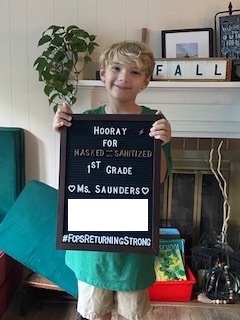
At the end of his first day in first grade, Locke’s favorite subjects in school are Snacks, Recess and Writing.
He is truly my grandson!!
— 30 —

.

Posted in Uncategorized | Leave a comment

First Day, First Grade

Today, the school year started for the first of our grandchildren — Locke is the first back to school this year, the others will follow over the next few days.

This is big deal for Locke — he’s in first grade! We talked to him a few minutes yesterday and he seemed excited — at least as excited as six year olds get about things they’re not sure what they’re getting into.

I think Dave took Lock to school this morning and he indicated that things seemed to go pretty well. It’s probably not surprising that I don’t remember my first day in first grade, but I remember a bit about our kids’ first day. Lots of anxiety for everyone. 

Even thought it’s exciting, it must be tough for kids…. they have to crawl out of a comfort zone that they have been living in all summer — actually their whole life. They have to listen to the teacher all day and focus on subjects that might be new to them and they might not care about…. and learn the “rules.”

I’m no expert on the subject, but I think the start of school might be better if there wasn’t so much emphasis on rules…. sure the kids have to learn school rules and regulations, but how about taking the first day or two and focus on getting the kids excited about learning. I don’t think introducing the rules slowly over the first week or two would create chaos — most kids today have enough basic understanding of social norms to be manageable for the first few days of adjustment. 

But anyhow, I’ve gotten off the subject. The subject is Locke — our first grandson and his first day in first grade. I’m pretty sure Locke is going to have lots of firsts in his life…. who knows, he may even be the first President born at INOVA Fairfax.  
— 30 —

Posted in Uncategorized | Leave a comment

The Test of Time

We were talking about urban legends the other day and the subject of Twinkies came up. I’m not sure why, but Twinkies seem to have always been a good topic for a tall tale, You’ve probably heard a lot or most of them yourselves. 

Can Twinkies really stay fresh for 50 years or more? If you were around during the Cold War in the 50s and 60s, when a nuclear attack from the Soviet Union seemed possible, you might think so. Apparently at the height of the Cold War, Twinkies were one of the staples of the survival foods people stocked in household bomb shelters. This probably helped spawn the notion that they could withstand not only a nuclear holocaust but also the ravages of time.

You may remember that back on November 12, 2016 Hostess announced that they were shutting down operations and selling off their assets. That meant no Twinkies — for a while at least, There was no doubt that the recipe and rights would be bought by another company. 

Twinkies were thought up by James A. Dewar, the Vice President of Continental Bakeries that sold products under the Hostess brand. Dewar came up with the idea for Twinkies while he was trying to come up with a way to utilize the machines used to make cream filled strawberry shortcakes when strawberries weren’t in season. The machines normally sat idle during this time. In fact, during the 1980s Hostess introduced a strawberry cream filled Twinkie, but it wasn’t successful. Twinkies were originally filled with banana cream, hence the coloring and shape. During World War II, bananas became scarce, so they switched to vanilla cream.

Dewar also came up with the name “Twinkies.” He was on the way to a marketing meeting and saw a billboard advertising “Twinkle-Toes Shoes” and came up with the name.

One of the artificial ingredients in Twinkies is cellulose gum, which gives the cream in Twinkies its smooth texture. Another place you can find cellulose gum is in rocket fuel.
According to research, it takes about 45 seconds to explode a Twinkie in a standard microwave oven.

I haven’t had a Twinkie in a long time (many, many years) but if I remember, they weren’t too bad. I read that more than 1000 Twinkies can be produced every minute — that equates to about 500 million per year. If that’s true, it puts the kibosh on my favorite Twinkie story…. Due to an error in market research, the company overproduced Twinkies two decades ago and hasn’t made any since, and will not resume production until all the “vintage Twinkies” are eaten.
— 30 —

Posted in Uncategorized | Leave a comment

Mysterious

If you’ve been following the news lately you’re probably aware of the so-called “Havana syndrome.” It’s been going on for some years, but the previous President didn’t pay much attention to it and we’re just learning how disorganized the government response to it was during that administration. There was no central way for departments to share reports of the episodes and many of the targets were intelligence officers whose identities and location could not be revealed.

Last Friday, President Biden’s top aides were told that experts studying the mysterious illnesses affecting scores of diplomats and their family members were still struggling to find evidence to back up the leading theory, that microwave attacks are being launched by Russian agents. The victims of the phenomenon experience unexplained headaches, dizziness and memory loss.

The National Security Council has begun an urgent effort to address the issue and two separate task forces are now in operation. The high-ranking nature of the investigation is an indication of how quickly the attacks, which date back to 2016, have risen from a medical mystery to an urgent national security issue.

The leading theory remains that microwave beams are aimed at government buildings and residences, either as part of an espionage effort or as a deliberate attempt to hit American officials with a debilitating, invisible and hard-to-trace weapon. 

One theory is that the attack began as an espionage effort that turned into a stealthy means of attack. Microwave technology has been used over the years by American adversaries to try to recreate documents by detecting the emissions of typewriters and then computer keyboards and cellphone communications. 

So far, the frustrating part is that there is still no definitive conclusion as to the cause that would enable the President to call out the Russians, the way he has with cyberattacks.

Information released last Friday indicated that the National Security Council was leveraging a broad array of scientific and medical expertise from within the government and outside it to explore multiple hypotheses and generate new insights into the episodes. 

One element of that effort is to develop portable sensors that could be widely distributed to detect attacks. But it is hard to ensure that the sensors would work without any certainty that microwaves are the cause of the unexplained illnesses. And — even if they are the cause, the sensors would have to be able to pick up signals across a large part of the electromagnetic spectrum.

This mysterious illness is disturbing, but I find it interesting that it surfaced during the Trump administration…. and when you think about it, lots of strange things and theories surfaced during those four years. The theory that the corona virus leaked from a lab in China, UFOs became a hot topic  after many years on the back burner and now the Havana syndrome…. seems like that four year period produced major unsolved mysteries on a regular basis. A lot of those things have not and maybe can not be resolved. The government has always had secrets, but for four years it seems like they also had a lot of mysteries. Secrets can usually, eventually be learned, but mysteries may never be solved. Right now, the Havana syndrome appears to fall into the mystery category.
— 30 —

Posted in Uncategorized | Leave a comment

Line Up

We voted early in the last Presidential election — at the county court house in Charles Town. We stood in line for a long time to vote…. I’d say the line was two or three blocks long. 
Well, that got me to wondering — when did people first start standing in line for things? 

I did some extensive research and found one study that indicated that the average person will spend 10 years in line over their lifetime. That sounds a little high to me, but a number of sources say Americans spend a staggering 37 billion hours waiting in line every year. 

Usually when I think of lines, the DMV immediately comes to mind — seems like there’s always a line there. One pretty much has to stand in line at the DMV, but I guess some lines people stand in voluntarily. I’ve seen lines of people waiting to get into restaurants, concerts and to buy the latest iPhones. I think basically human beings hate standing in lines, but in some lines, people seem to love being in front of them.

It seems like the modern concept of lines, or queues, started in revolutionary France and made its way to English shores around 1837. The first written description of people standing in line is found in The French Revolution: A History by Thomas Carlyle. Along with descriptions of the head chopping by guillotine and street mobs, Carlyle described the queues in Paris —at bakery shops, in a time of massive famine and bread shortages among the peasants. The book also discussed the political aspect of queues. The slogan of the French Revolution was “Liberty, Equality, fraternity,” so to patiently wait one’s turn was to hold everyone as equals. In America, we believe that all are created equal, so we, too, stand in line. 

The British have long had a reputation for embracing queueing. The idea that the British are willing, patient and even eager to stand in line dates to World War II propaganda during a time of shortages and rationing — and is a myth. In fact, queues were often tense and politically charged that had to be policed in case of riots. 

One theory has it that “queuing” came about because leaders decided they had to deal with the disorderliness of their urban centers. Simply stated, they wanted to tame the crowd. They created straight, well-organized streets. Sidewalks were built to separate pedestrians from traffic and encourage them to walk in a straight line. Police forces were told to “keep people in line.” Also, over the years, schools have played a role — kids are taught not to cut in line, and mind the rules.

Interestingly, there have been a number of studies that focused on lines. The studies all revealed a social system in miniature — complete with competition and cliques. The studies found that querers at the front formed alliances, creating rules that allowed people to leave while others protected their spots. People talked more to each other the closer to the front of a line they were. They cooperated and established disciplinary rules, shared interests, played games, prepared food, told stories and did favors for each other. When they fought, they resolved disputes, sought leadership and conferred authority.

I found a long article about the 2008 Olympic Games held in Beijing. For a year prior to the start of the games, the Chinese government’s Office of Capital Ethics Development ran a campaign explaining that public spitting and littering were discouraged and thousands of pamphlets were handed out educating the citizens about proper “street etiquette.”
The Chinese character for the numeral 11 resembles two people standing in line. The ethics office put up signs that read in Chinese: “I wait in line and am cultured. I display courtesy and am happy.” and “It’s civilized to queue, it’s glorious to be polite.” 

So people have been, and will continue, standing in line for a very long time. I don’t consider myself an especially impatient person, but standing in a slow-moving line is one of those small, maddening aspects of life that drives me crazy. Maybe since my extensive research has given be more insight to lines, I’ll be more patient.
Nah — the older I get, fewer things seem worth waiting in line for.
— 30 —

Posted in Uncategorized | Leave a comment

Maybe Just Drink Wine

The diplomatic relationship between the U.S. and Russia has always been a little “different.” Call it “games,” or whatever you want but the two countries have always spared over all kinds of issues — significant and trivial.

Having had a bit of first-hand experience in the past, I thought it was interesting to read a day or so ago about one of the latest ‘Incidents.” 

Back in April, Russian President Vladimir Putin made a ruling prohibiting any locally-hired employees from working for the U.S. — the only exception being security guards. That ruling became effective on August 1. 

Ten years ago, there were close to 350 U.S. diplomats in  Russia who were supported by about 1,900 “foreign service nationals.” Many of the “local hires” performed routine administrative, technical, cleaning, maintenance, and cooking chores. Now, American foreign service officers will have to take time away from issuing visas and other diplomatic chores to clean floors, do laundry, etc. 
Putin’s move was a reaction to the U.S. kicking out some Russian diplomats this past spring. 

On August 5th, the U.S. State Department issued a Russia Travel Advisory, warning Americans not to travel to Russia due to possible terrorism and harassment by Russian government security officials. The advisory went on to say it was issued because the arbitrary enforcement of local laws left the embassy with limited ability to assist U.S. citizens in Russia. 

So — if you were thinking of a trip to Russia to pick up a bottle or two of good vodka, you might want to re-think those plans.
— 30 —

Posted in Uncategorized | Leave a comment

Happy Valentine’s Day

Today is one of those Chinese holidays that we celebrate. Both readers of this blog know that Valentine’s Day on February 14th is celebrated by us either before or after the actual holiday because restaurants are just too crowded on the 14th.

So today, we get to celebrate Valentine’s Day on the actual date — restaurants aren’t generally overflowing on Chinese Valentine’s Day. Chinese Valentine’s Day falls on the 7th day of the 7th lunar month of the Chinese calendar — this year, it’s today, August 14.

This Chinese holiday goes by different names — originally it was called the Double Seven Festival. Its formal name in Chinese is the Qi-Xi Festival. And it sometimes goes by the name of The Daughter’s Festival — the day for unmarried young girls looking for love.
In China, on Chinese Valentine’s Day, people in love like to go to the Temple of Matchmaker and pray for their love and possible marriage.

As I mentioned, today is also known as The Daughter’s Festival. Long ago, Chinese girls always wanted to train themselves to have a good handcrafting skill like the Weaving Maid. The skill is essential for their future family. On the night of the festival, unmarried girls may pray for the Weaving Maid star to let them become smarter. When the star Vega (the Weaving Maid star) is high up in the sky, girls do a test, which is to put a needle on the water surface. If the needle doesn’t sink, then the girl is already smart enough and ready to find a husband. Girls may ask for any wish, but only one per year.

But for me, at least, this Valentines’s Day is even better than the one in February — the restaurants aren’t crowded, you don’t have to order from a special menu and although nothing says you have to have Chinese food today, I think today’s a good day for it… and of course top it off with some plum wine.
— 30 —

Posted in Uncategorized | Leave a comment