A lot of times when we go to Costco, I get muffins — and of course at Costco, you get a lot of muffins. Claire puts some in the freezer…. I like the muffins and it’s an easy breakfast — just eat them, or, if they’re frozen, pop them in the microwave for a few seconds.
I’m not sure how this subject came up, but it did and a friend told me that muffins are just ugly cupcakes. I’m not sure if that observation was made to offend me or just made to see where the conversation would go. But it did get me to thinking…. I guess maybe it’s kind of true. But I like muffins and I like cupcakes — and — I’ve always heard that beauty is in the eye of the beholder.
I figured this was a good subject for some extensive research — you may not be surprised that I found absolutely no data that would support calling a muffin an ugly cupcake. But — I did run across some interesting stuff… a lot of states have official foods of some sort, like official state cookies or cakes, etc.
If you’re a muffin fan, you may want to jot down this information…. I understand that this may be startling news to you, but I’m pretty sure that no state has an official state cupcake — but muffins are another story. Three states have passed legislation making certain types of muffins official in their states: Minnesota — Blueberry Muffin Massachusetts — Corn Muffin New York — Apple Muffin
Four states have unofficially declared state muffins, but legislation to make it official is pending: Hawaii — Coconut Muffin California — Poppyseed Muffin Texas — Chocolate Chip Muffin Washington — Blueberry Muffin
(I’m a little concerned that Washington is contemplating the Blueberry Muffin after it has already been claimed by Minnesota. It may not seem like a big deal, but civil wars have grown our of seemingly insignificant events….) So to cupcake lovers, muffins may be ugly, but legally they have more status. — 30 —
Well, here it is again — August 6 — my birthday. You all know I’m not a particularly big fan of birthdays and especially not of mine. But, on August 6, 1938 I was born — I figured now is a good time to take a look at that day and its significance.
August 6, 1938 was a Saturday and the 218th day of the year. It was also the 32nd Saturday of 1938. If my parents had saved their 1938 calendar, it would have been useless until this year. The 1938 and 2022 calendars are exactly the same.
Up until today, there have been 1,039 full moons and I became my first one billion seconds (1,000,000,000) old sometime on April 14, 1970. I don’t share my birthday with any really famous celebrities — about the most famous is Alfred Lord Tennyson, the English poet, born on August 6, 1809.
In case you might have the occasion to write the day I was born in Roman numerals, it would be VI.VIII.MCMXXXVIII (using the DD.MM.YYYY format.) You’d never know it by listening to me, but I’m a member of the Silent Generation.
I’m not really into numerology, but apparently everyone has a life path number based on their date of birth. Each number from 1-9 holds a vibration and each vibration produces a predictable characteristic or outcome around it. Numerologists believe that we have all had previous lifetimes.
Based on my birth date (8/6/1938) my life path number is 8 — it represents experience, authority and endeavor. I am gifted with natural leadership and the capacity to accumulate great wealth. (Apparently the operative word in the last sentence is capacity.) And the lessons learned from my last past life: I should develop my talent for love, happiness and enthusiasm to distribute these feelings to all people.
On August 6, 1938, in the United States, the most popular girl’s name was Mary — the most popular boy’s name was Robert…. not Jimmy, but Robert.
So there you have it — it took 84 years to be able to re-use the calendar when I was born, but I guess I don’t need a calendar if I count my age by friends, not years. — 30 —
I think I’ve mentioned before, that China has a number of “Valentine’s Days.” In the United States, we celebrate Valentine’s Day on the 14th of February. And fairly recently, 2/14 has become a popular celebration in China — imported from the West. It’s particularly popular among the younger generation — much like in the West, Chinese couples spend time together by going to the movies or for romantic dinners.
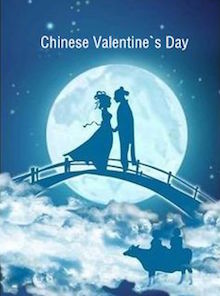
But today, August 4, 2020, is also Chinese Valentine’s Day — In China, it’s known as the Qi Xi Festival, often called the Qixi Festival. It is celebrated on July 7th (7/7) on the Lunar calendar, which means the date on our calendar usually falls in the month of August — this year, it’s today, August 4th.
The Qisi Festival comes from the romantic tale of two lovers who can only come together once a year, which is why it’s celebrated on this day. If you’re researching this particular Chinese Valentine’s Day, you may find it listed under different names, such as the Double Seven Festival, or the Daughter’s Festival. It’s sometimes referred to as the Double Seven Festival because in literal terms, the word “qixi” means “evening of sevens” as it represents the seventh day of the seventh month per the Chinese lunar calendar.
Since this is a Chinese Valentine’s Day, people celebrate the occasion as a day of love by buying presents for their spouses or romantic partners… however, the Chinese like to observe the day by following various local customs.
The Qixi Festival has its roots in ancient Chinese folklore. The legend goes that Zhinü, a weaving girl from Heaven, descended to Earth and fell in love with a mortal named Niulang. They married each other without the knowledge of Zhinü’s mother, the Goddess of Heaven. Zhinü bore Niulang two beautiful children and lived happily until her mother learned of her transgressions, went into a rage, and sent soldiers to retrieve her. Zhinü went back to Heaven. Sometime later, Niulang tried to rescue his wife, but the Goddess of Heaven took out her hairpin and created a massive river, thinking she had separated the lovers forever. However, Niulang and Zhinü’s love was stronger than she thought. It moved the magpies so much that they flew up to Heaven to form a bridge over the river. Seeing the love between her child and a mortal man, the Goddess of Heaven allowed the lovers to meet on the Magpie bridge on the seventh day of the seventh lunar month every year — and that’s how the Qixi Festival came into being.
According to several Chinese beliefs, the river represents the Milky Way, while Zhinü and Niulang represent the constellations of Vega and Altair. The festival was first recognized as a formal occasion during the Han Dynasty, over 2,600 years ago. Although it sounds romantic, the festival was not initially intended for lovers but for young girls to worship the weaving fairy and hone their skills at handcraft.
So if you’re like me, and hate the crowds at restaurants on February 14th, this Chinese Valentine’s Day may be your cup of tea. We usually get a quizzical look when we tell the waiter that we’re celebrating Valentine’s Day, but we always get the same look when we show up the day before, or after our “traditional” Valentine’s day, too. Happy Chinese Valentine’s Day.
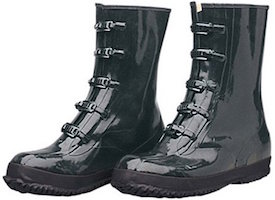
We’ve had a lot of rain this year and while I’m not usually out much in it, it brought to mind something my mother always told me as a kid when I went out in the rain — “put on your galoshes.” That’s one of those words you don’t hear much anymore. I think we usually told our kids to put on their boots when it was raining out. I’ve also heard things you wear on your feet when its raining referred to as rubbers, gumshoes, overshoes and dickersons and in England I know they’re called Wellington boots or just “wellys.” So these things you slip over your shoes to keep them from getting wet or muddy go by a number of names. As I said, I rarely hear the term galoshes used anymore, and maybe rightfully so. I’ve learned that technically, galoshes and rain boots aren’t the same and the names shouldn’t be used interchangeably. Rain boots are intended to protect the feet and lower leg, while galoshes are more about protecting shoes.
We get the word from French (galoche) and Latin that picked it up from Greek and it originally meant a shoemaker’s last — literally “wood” + “foot.” By the 14th century, the term was used to describe English style clogs — those with a wooden sole, and fabric or leather “uppers.” Later, the term also applied to an overshoe with a shaped wood base to raise the wearer’s good shoes off the ground.
The credit for the transition from a traditionally wooden sole to one of vulcanized rubber goes to Charles Goodyear with some assistance from Leverett Candee. The vulcanization of rubber gave it properties that made it easily molded, durable, and tough. A rubberized elastic webbing made galoshes produced in the 1890s by Goodyear easy to pull on and off.
So the galoshes as I know (or knew) them became popular in the late 19th century. I remember the galoshes that I had when I was a kid being about ankle-high rubber boots that were supposed to, but almost never did, fit over my shoes and they had fasteners that were hard to fasten and would often pinch your fingers when closing or opening them. I’ve seen pictures of galoshes with zippers, but when I was a kid, mine all had those nasty little fasteners. It’s too bad, but our grandkids will never remember being told to “put on your galoshes”……. — 30 —
Every year, I say, “Wow, here it is August already!” But it’s true — here it is August already! For some reason, I’ve kind of gotten into the habit of talking about each upcoming month — so today, it’s August’s turn…
I’ve mention before that August was once the sixth month of the year. In the original ten-month Roman calendar, the month went by the name of Sextilis. meaning “the sixth month” in Latin. Then around 700BC, August was rudely shoved back in the order of months because January and February were added to the beginning of the year by King Numa Pompilius. August has also gone through a number of changes in its number of days. In the old ten-month calendar, the months all had either 30 or 31 days that totaled 304 days in the year. Not only did Pompilius add January and February, he also reduced the number of days in August down to 29. It didn’t get to keep 31 days until Julius Caesar introduced the Julian calendar. And finally, in 8BC, the month was named Augustus — in honor of the Roman emperor Augustus.
If you’re a traveler, you probably know that parts of the world, especially a lot of countries in Europe, consider August to be their “holiday” period. A lot of the major cities are almost completely empty of locals. Of course, they’re filled with other people or tourists taking their holidays.
In the UK, Lammas Day is celebrated as the first day of harvest on August first. Traditionally it was the day in which harvested wheat would be baked into bread and given to the church. This bread was used as the Communion bread for a special Mass to celebrate the beginning of harvest. That tradition ended when Henry XIII broke away from the Catholic Church.
August is noted for a few other things besides it being my birthday month — Martin Luther King Jr. gave his famous “I have a dream” speech on August 28, 1963. Booze of some sort appears to get a special day in every month — August is no exception, with August 16 being National Rum Day. And I learned 50 years ago while living in Manila, August is the Month of Philippine Language. Elvis fans always remember his passing, on August 16, 1977, although not all bought into his death…. I remember someone saw him in Food Lion here in Shepherdstown not too long ago.
And in case you’re wondering, August is a relatively common name for boys in Sweden, but only twenty two percent of Swedish boys named August are actually born in August.
So there you have it — August in a nutshell…. even though it’s referred to as the dog days of summer, it’s the last real summer month, so get out an enjoy the warm weather. — 30 —
A few days a go, I was again on the topic of time. That particular entry discussed Planck time and got a little complicated…. so today I thought we’d tackle the old question, does time really go faster as we get older. Most of us, at one time or another, have said that time seems to go by faster the older we get — so does it really?
Like so many things, I obviously don’t know the answer to this question, but it may just be a matter of perspective. When you think about it, one year to a five-year old is a significant portion of their lifetime to date, but to an 80 year old, it’s just a tiny fraction.
People more knowledgeable than me on the subject say it has more to do with how, the older we get, the more familiar life becomes, and the more we “chunk” our experiences into basic categories like work, shopping, commuting, etc. A study found that prompting people to categorize the previous year in that way led them to feel that it had passed more quickly. On the other hand, being mindful and savoring each experience as if it were new tended to trigger the sensation of time passing more slowly.
So maybe time is what you make of it — I’ve heard it said that those who make the worst use of their time are the first to complain of its brevity. — 30 —
A few blogs ago, the subject was Carry Nation and her campaign to abolish alcohol from the face of the Earth. Unfortunately, Carry died before the U.S. established nationwide prohibition in 1920. Prohibition was repealed in 1933. So a good part of the 20th century was a merry and “wet” one for a lot of folks.
But in the 1960s and 70s, a wave of Puritanism quietly swept over America where the citizens had spent more than two decades in indulgence. A foreign substance crept in and corrupted our youth. Called marijuana, or cannabis, or pot, or weed…. it was not drunk, but inhaled — totally alien to our traditions. This new vice quickly spread throughout the land and suddenly, being stoned was a lot more fashionable than drinking. Plus — drinking was now legal and the new stuff wasn’t.
I wasn’t around for prohibition, but I did grow up in a “dry” state (Oklahoma.) The attitude there was that alcohol was the root of all evil, a bit like the use of marijuana is today, or at least maybe until recently.
Alcohol had been a part of America culture for hundreds of years. Some/most Native American tribes used alcohol for ceremonial purposes during the precolonial era. But then there’s the cannabis plant…. medicinal use of cannabis didn’t make its first appearance in America until the 1850s.
It’s interesting that varieties of cannabis plants are also known as hemp plants, although the word hemp is more commonly used when referring to fiber derived from the plants. Hemp, the fiber, has been used extensively throughout history for items like rope, paper, fabrics and boat sails. (In colonial America, hemp production was a requirement of English rule, and George Washington grew it as one of his main crops at Mount Vernon.)
As I mentioned, in the 1850s, products with cannabis extracts were first produced and sold for the purpose of treating illnesses such as pain and muscle spasms. Soon after, pharmaceutical regulations were introduced in individual states. Products containing habit-forming substances like cannabis were often labeled poison and, in some cases, were available only with a physician’s prescription.
So it seems like marijuana use and acceptance is following a similar path that alcohol did on its way to acceptance. But it is becoming more acceptable — I saw a sign the other day that said, “It’s CANabis, not CAN’Tabis.” And it seems like it’s even gotten a thumbs up from a couple of presidents… “Some of my fines hours have been spent on my back veranda, smoking hemp and observing as far as my eye can see.” ~ Thomas Jefferson “I don’t think [pot] is more dangerous than alcohol.” ~ Barack Obama So have a happy day….. — 30 —
Over the years that I’ve been writing this blog, the subject has been “time” on a number of occasions. From daylight saving “time” to Greenwich Mean Time (GMT) which is now referred to as UTC (Universal Time Coordinated.) Various times have fascinated me and with the advanced technologies and space travels, time, particularly accurate time, is more important than ever.
One of the fundamental mysteries surrounding the concept of time is whether it’s continuous and our chronological measurements are just a way of making sense of it, or if it actually breaks down into discrete “ticks” that are very tiny.
So time is an abstract concept at best, but the dimensions for measuring time are so tiny that the classical laws of physics don’t really count. The smallest viable measurement of time is derived from a unit of distance called the Planck length. That’s where dimensions become so small that the classical laws of physics break down and quantum effects kick in. That point is about 1.6 x 10⁻³⁵m. From that point, physicists speak of the smallest theoretical period of time as being the interval required for a photon traveling at the speed of light to cover the Planck length, or just 0.5 x 10-43 seconds.
Recently, scientists at Goethe University in Germany actually measured the world’s smallest unit of time and its called a zeptosecond. The scientists measured how long it takes for a photon to cross a hydrogen molecule — around 247 zeptoseconds — making that measurement the shortest time span ever successfully recorded. A zeptosecond is a trillionth of a billion of a second. In case you’re interested, that’s a decimal point followed by 20 zeroes and a 1 — it looks like this: 0.000 000 000 000 000 000 001
A yocotosecond is a septillionth of a second — but has not been measured and recorded. If you’re interested in why anyone even cares, scientists hope the information will be helpful in quantum computing and superconductivity. Also, in case you’re interested, the best atomic clocks can measure down to a tenth of a billionth of a billionth of a second (ten to the 19th power.)
When I say something didn’t take very long, I always use “nanosecond” — I never knew that was such a long period of time. — 30 —
When I was a kid growing up in Maysville, anytime the weather was decent, we were outside. We weren’t poor, but I didn’t have a lot of “store-bought” toys — nobody did. So my friends and I made a lot of our “toys,” or various things to play with and/or occupy our time. In the past I’ve mentioned some of the things we made and talked about making things with and for our kids, even though when they were young, there were a lot more “story-bought” toys available.
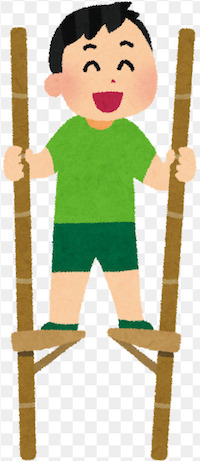
Today, July 17, is one of those special days that often goes unnoticed — it’s National Walk on stilts Day. Stilts are one of the things we usually made every summer, and of course, the older we got the higher we made the stilts.
I hadn’t thought about stilts for a long time and it’s not a subject that gets much notice today. I suppose kids still walk on stilts, but I don’t remember seeing a kid on stilts in a long, long time. When stilts come to mind, you usually think of a circus — just about every circus has some guy walking on really high stilts.
I usually think of stilts in terms of “entertainment,” but they are used in many industries, especially the construction industry. Stilts are even used in sheepherding — in France, shepherds used them to watch their flocks from an elevated position. In construction, there is often a need to work at a height above the ground higher than a worker can reach, and where constantly moving a ladder is a pain. A good example of this is the drywall industry — in fact if you check Amazon, you can buy drywall stilts.
So anyhow, when I noticed it was Stilts Day, I thought it might be a good time to talk about something else that was popular in my childhood that’s just about disappeared today…. On the seacoast of southern France, there is a soggy region called Les Landes. As the seasons change, the earth changes from salt marsh to damp plains, most of it isn’t either land or water. For centuries, the people their found their own strange way to live with those conditions — they relied on stilts. Propped up on stilts, shepherds tended their flocks, mail carriers made their rounds, stumping on their stilts. Stiltwalking housewives, chatted in the market in their black clothes, and were said to resemble large ravens perched on dead branches. The children did their chores, went to school, and played sports — all on stilts. The people of this region became the most skillful stiltwalkers in the world.
Workers in the fruit orchards of California have a saying, “One pair of stilts is worth a dozen ladders.” Stilts are commonly used to prune and harvest the trees in a handy and efficient manner. I mentioned stilts in the circus — one famous circus performer lives in London near Piccadilly Circus, which isn’t a circus, but a busy circular area in the heart of the city. Harry Yelding claims to hold the world’s record for waling on the tables stilts — as a clown, he performs on stilts that measure twenty-two feet from his ankles t the ground. He sometimes strolls through the London streets, window-shopping in third-story windows. Even though Yelding gets a lot of publicity, his stilts are not the highest — in 2008, Roy Maloy of Australia took 5 steps on stilts 46 ft. high, claiming the unofficial world record. Archaeological ruins and texts show that stilt-walking was practiced in ancient Greece as far back as the 6th century BC.
The stilts that I made as a kid, were hand-held stilts — they weren’t tied or strapped to my legs, I just stood on a “step” attached to a pole. But there are other type of stilts…. Peg stilts, also known as Chinese stilts, are often used by professional performers. These stilts strap on at the foot, ankle, and just below the knee. The stilt walker needs to keep moving to keep their balance. I mentioned earlier drywall stilts — these are designed to allow the stilt walker to walk or stand still. Spring stilts are spring-loaded stilts that allow the user to run, jump and perform various acrobatics. Digitigrade stilts are peg stilts whose line follows the foot and not the shin bone — this allows costumers to mimic some animals. Articulated stilts are similar to drywall stilts in that they allow the stilt walker to stand in one place without shifting their weight from foot to foot. This are commonly used in theme parks.
So stilts provided me entertainment as a kid, but it was something kids do — as we get older we have to realize that… Someone said that it is in vain that we get upon stilts, for once on them, it is still with our legs that we must walk. And on the highest throne in the world, we are still sitting on our own ass. — 30 —
I had my car inspected recently and while I was looking for my proof of insurance card and the receipt that said I’d paid my taxes, I ran across a whole bunch of other stuff — stuff that I have no idea why it hadn’t been thrown out.
Cars used to have glove compartments — a little door on the dashboard in front of the passenger seat and that’s where you put stuff, like the owners’ manual. Well, actually, that little compartment still exists — the door is pretty much where it’s alway been, but I’m not sure I’ve ever opened that little door more that once or twice since I’ve owned the car.
All the cars now have another compartment between the drivers seat and the front passenger seat — that’s where all the stuff goes in my car — not the “glove” compartment.
While I was looking for my insurance and tax forms, I ran across a roll of quarters — Claire put them there in case we needed them for a parking meter, two cell phone chargers that fit into a cigarette lighter socket — my car doesn’t have a cigarette lighter — it has a USB outlet for phones, a bag of cough drops, a flashlight, a “wonder tool” that has about a dozen “tools” — kind of like a Swiss Army knife. A pack of Kleenex. Two tire gauges — one analog, one digital. A listing of all the sirius radio channels. A large pack of coupons from Bed, Bath & Beyond — mostly expired, some in 2016. A couple of old Covid masks. A USB charging cable that actually fits my phone, a couple of pieces of paper of unknown origin, an emergency flasher, and a couple of loose coins. There was no owners’ or operators’ manual — that’s the only thing in the glove box on the dash.
I suppose I should probably get in the habit of cleaning out this storage console more regularly — maybe at least every year when I get the car inspected… kind of like changing the batteries in the smoke detectors when you change the clocks for daylight savings time — but at least that happens twice a year, my car only gets inspected once a year.
I’ve always tried to keep my cars relatively clean and clutter free — even the “glove” compartments and the trunk. But I have to admit that lately I’ve let both of these areas get a little messy.
It occurs to me that my car has lights and warnings for just about everything — if my seatbelt isn’t fastened, the door or window is open, if I forget to hit the “off” button (it’s a “hybrid”) when I get out, when the car needs maintenance or an oil change. It seems to me it wouldn’t be so hard to add some sort of notification to clean out the glove box periodically….. — 30 —