Goodbye….

Well, when you wake up tomorrow, it will no longer be August. 
We’ve made it trough 243 days of 2022 — there are122 left. It’s the 36th week of summer and just 22 days before fall.
Today the sun rose at 6:40 am and it will set at 7:46 pm, making today 13 hours and 5 minutes long. And let us not forget that on this day in 1897, Thomas Edison patented the Kinetoscope — the first movie projector, and 100 years later in 1997, Diana, Princess of Wales died in a car crash in Paris.
As someone once said, may the wind of August lift you up, elevate you and blow you in the right direction.
Goodbye August…..
— 30 —

Posted in Uncategorized | Leave a comment

ABC

A few blogs back, I talked about Calvert Liquors and its importance when I first moved to the Washington area. When I first arrived in the area, buying hard liquor in the state of Virginia was complicated and frustrating. It could only be purchased in a state owned “ABC” store. Those stores had a counter across the front, and rows of gray metal shelves filling the remainder of the floor space. You had to ask the person behind the counter to get you what you wanted — no looking to see what they had, or touching the bottles — even if the employees had been friendly (in fairness, a few were) it wasn’t a very peasant shopping experience. And forget about going to a restaurant and having a cocktail before dinner or with your meal.

After prohibition ended, Virginia authorized retail stores to sell beer and wine, but retained direct control over the sale of hard liquor. The General Assembly set up what is today the Virginia Alcoholic Beverage Control (ABC) Authority and gave it the exclusive right to sell hard liquor directly to the public.

Until restaurants were authorized, in 1968, to sell liquor by the drink (one glass at a time) the only legal hard liquor sales in Virginia were bottles handed by ABC clerks to customers standing on the other side of the counters in state-owned stores. (The one glass at a time rule was interesting — if you were in a restaurant having a drink, and ordered another one, the first drink had to be finished, and the server had to take the first drink off the table before placing the second drink on the table!!) Shortly after the state authorized liquor by the drink, the Virginia Administrative Code limited advertising that used the words Bar Room, Saloon, Speakeasy, and Happy Hour — hoping to minimize the potential for excessive drinking.

Virginia now permits billboard advertising of alcohol, but billboards may not depict persons consuming alcoholic beverages, may not use cartoon characters, nor use persons who have not attained the legal drinking age as models or actors. The billboards may not be placed within 500 feet of a church or synagogue, a public, private, or parochial school, college or university, a public or private playground or similar recreational facility, or residentially zoned property.

The only competition for the sale of bottles of hard liquor in Virginia comes from moonshiners selling untaxed and illegal liquor, often in one-galloon plastic jugs and even the classic Mason jar.

The hours of operation, the brands sold, the price of different products and the locations of ABC stores are determined by the state — not the local authorities.

I mentioned that Virginia only permitted liquor by the drink in food establishments beginning 1968 —this move eliminated the “brown bag” requirement that customers join a private club and bring their own bottle to the restaurant (typically in a brown paper bag) in order to enjoy a drink before a meal.

It’s interesting that in 2020, when Governor Northam issued Executive Order 53 closing all dining and congregation areas in restaurants, dining establishments, food courts, breweries, microbreweries, distilleries, wineries, tasting rooms, and farmers markets during the COVID-19 pandemic, he declared beer, wine, and liquor stores to be “essential retail businesses” which could stay open.
I think that laws and regulations that regulate liquor must use the same algorithm that airlines use to determine air fares…..
— 30 —

Posted in Uncategorized | Leave a comment

The Truth

There was an article on the news couple of days ago that mentioned that Hedy Lamar (the movie actress) invented a key part of the technology that makes wifi, GPS and cell phone technology work. Apparently there are a number of inventions that are attributed to people famous or known for other reasons. For instance, the first artificial heart was patented by Paul Winchell, a popular ventriloquist when I was young and recently the voice of Tigger in Disney’s Winnie the Pooh cartoons.
And Zeppo Marx invented the first moist heating pad, a clamp that is still used in the space program and the first wristwatch that could measure a person’s pulse.

And then there was William Marston — to say he had an unconventional life would certainly be an understatement. He had three degrees from Harvard, one a PHD in psychology. 

The Systolic Blood Pressure Test was invented in 1915. The Systolic Blood Pressure Test would be incorporated into the Polygraph Test, the modern version of the “Lie Detector” Test.
Wonder Woman was created in 1941. The fictional heroine debuted in DC Comics.
What do these two things have in common? They were created by the same person — yep, William Marston. 

Marston began work on his Systolic Blood Pressure Test in 1915 while attending Harvard. He became interested in the idea that the difference in a person’s blood pressure might determine their mood when his wife, Elizabeth said “Whenever I get mad or excited, my blood pressure seems to climb.” Marston came up with the Systolic Blood Pressure Test with the hope that the spikes in a person’s blood pressure could deduce whether the person was lying when asked a series of questions. 

Marston did a lot of work with the polygraph, trying to commercialize it. As a result of his work, he became convinced that women were more honest than men and he also thought they could work faster and more accurately at many jobs. That was pretty radical thinking back then.

Not only was Dr. William Marston an internationally famous psychologist, that was obsessed with people’s personalities, and their secrets, he was also a prolific writer of screenplays, novels and articles — and — a consulting psychologist for Universal Pictures. 

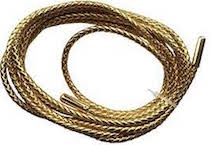
In 1940, he was hired by Maxwell Charles Gaines, the founder of All-American Comics that published the popular Superman and Batman comic books at that time. However, the comic books were being criticized for their violence and sexual imagery. Marston was appointed to the editorial board for the comics and he believed the best way to counteract what he called the “blood-curdling masculinity” of the comics world was with a female superhero and he submitted his script for Wonder Woman in February of 1941. Wonder Woman’s signature secret weapon was the “Lasso of Truth” — a golden rope. While bound with it, anyone was compelled to tell the truth and do as she commanded. The lasso worked much better than a polygraph, but it’s pretty clear that Dr. Marston came up with Wonder Woman’s golden lasso because of his work on the polygraph.

So as to not offend any Wonder Woman fans, I should mention that the Lasso of Truth was previously owned by the Greek Goddess Hestia and it is sometimes referred to as the Lasso of Hestia. The lasso itself is approximately twenty feet long — that gives it sufficient range while not compromising the user’s ability to wield it easily. However, its length can be magically extended to allow for extra range. After reading the news today, I think one of these might come in handy today…
— 30 —

Posted in Uncategorized | Leave a comment

Smidgen

Claire heard someone use the word smidgen the other day and remarked that it was a term you don’t hear much anymore. I guess I agree, and in this digital age of exactness, it probably makes sense. It seems like today everyone has to be precise in their measurements — everything from time to various other measurements. Traffic signs even tell you exactly how far you are from some place, and how long before you’ll get there. So with our GPSs telling us exactly how long it will take to get somewhere, it’s no wonder smidgen doesn’t get a lot of use. Smidgen is a little bit of something — hardly precision enough for today’s world. 

Another word you don’t hear used often is skosh — a skosh is a hair less than a smidgen! I can see why that word doesn’t get much use either. Actually, according the dictionary a skosh is a small amount: bit, smidgen.

I don’t know that I ever used smidgen too much, but I used to use the term skosh all the time when in the Far East, especially Japan and Korea.
I did some checking and during the occupation of Japan at the end of World War II, US forces borrowed some vocabulary from the Japanese. One word was sukoshi, meaning “little” or “few.” It was used to describe quantities, time or distances. Apparently the Americans dropped the u and i, yielding skosh.

So even though smidgen and skosh don’t provide the precision we need in today’s world, they’re still fun to say even though a lot of the younger generation don’t know what we’re talking about…..
— 30 —

Posted in Uncategorized | Leave a comment

Caboose

I am, and always have been, a big fan of trains. Train tracks run right through Shepherdstown and we often get stopped by trains. Some of the trains a pretty long, and sometimes it’s a long wait for them to pass, but this is a minor annoyance compared to a lot of other things that annoy me.
Anyhow, a couple of days ago, we were stopped and when the end of the train went past, I remarked, “well, there’s the end.” Claire said, “and no caboose.” 

Caboose is funny sounding word and when I was growing up, all freight trains had a car at the end of the train called the caboose. When I was little, we used to wait for the caboose at the end of the train to give the crew a wave when they passed by — they always waved back.
For many years, cabooses were a part of every railroad — what happened to all those cabooses?

The caboose was introduced in the 1830s — its earliest beginnings can be traced back to a small railroad in upstate New York and a crewman named Nat Williams that worked on the Auburn and Syracuse railroad. Nat converted a little used boxcar into a small space to store items and keep them organized. Additionally, he took care of the railroad’s paperwork in this car at a makeshift desk, made out of a wooden barrel.

The early cabooses were no more than just flat cars with a cabin built atop them to shelter the crew working the rear of the train. They developed into separate cars with a platform on either end, and a cupola on the top, that acted as a lookout tower for the train crew. The cabooses were fitted with red lights, called markers, to enable the rear of the train to be seen at night. (This led to a common railroad phrase, “bring up the markers” to describe the last car on a train.) 

Cabooses provided the train crew shelter at the rear of the train. The crew could exit the train for switching, inspect the train for problems and to protect the rear of the train when stopped. the conductor kept records and handled business from a table or desk in the caboose. For long trips, the caboose provided minimal living quarters and was frequently personalized and decorated with pictures and posters. 

As the world progressed, many cabooses were phased out from mainline freight trains and the end of train (EOT) device became standard railroad equipment. Also, various technological advancements were introduced including remote switching and defect detectors. So while cabooses worked for the railroads for well over one-hundred years, the new technology provided increased accuracy and significantly decreased operating costs. The EOT performed all the duties of the caboose and didn’t require any additional manpower.

Just about every caboose I remember was painted red — I know that not all were, but  almost all were. Red was chosen to increase visibility. Railroads wanted to paint their cabooses a color that could easily be seen from a distance for safety.

I suppose that I should mention that the word “caboose” is defined by Merriam-Webster as “a part of a train that is attached at the back end and is used by people who work on the train.” If you didn’t already know what a caboose was, I’m not sure you could draw much of a mental picture from that description…. so I dug a little deeper than Merriam-Webster and found out that the first “caboose” had nothing to do with railroads. The word first appeared in English in the mid-18th century and meant a small cooking cabin or kitchen on the deck of a merchant sailing ship. It was also used to mean the cast iron cooking stove inside the cabin. The word caboose comes from the Dutch “kabuis” (or Low German “kabuse”) meaning “cabin on a ship’s deck.” The use of caboose to mean a crew car on a train didn’t come along until the mid-19th century.

So I guess that’s about enough for today…. see? my train of thought does have a caboose.
— 30 —

Posted in Uncategorized | Leave a comment

State of Sports

When I was growing up I alway heard that baseball was our national sport. Thinking back, I think that was probably true. Every fall, the major topic of conversation when any group got together was the World Series… today — not so much. I did some checking, and it turns out that, based on revenue, the top major sports leagues in the US are the National Football league (NFL); Major League Baseball (MLB; the National Basketball Association (NBA); the National Hockey League (NHL); and Major League Soccer (MLS) — in that order. 

But I got to wondering…. what about the states? Sports are an important part of culture in the United States, so I figured since states have state flags, flowers, nicknames, mottos, trees, and some even have state dinosaurs, that the states must all have official sports. But that’s not true — I think every state has a state bird, and even though sports are very popular in the United States, every state doesn’t have an official sport — only about 15 do — and having a state sport is a fairly recent thing.

So as a public service to you faithful blog readers, here’s what my extensive research turned up:
Maryland became the first state to adopt an official state sport in 1962. The sport? Jousting. In 2004, Maryland also adopted lacrosse as its official team sport. The other states that have adopted official sports (all after 1962) are:
Alaska — (Dog) Mushing. 
Michigan — Wakeboarding. (A water sport in which the rider, standing on a wakeboard (short board with foot bindings) is towed behind a motorboat across its wake — a combination of water skiing, snowboarding and surfing.)
Hawaii — Surfing. (Team sport — Outrigger Canoe Paddling.)
New Hampshire — Sking.
Texas — Rodeo
South Dakota — Rodeo
Wyoming — Rodeo
Massachusetts — Basketball (Team sport — Volleyball)
Minnesota — Ice Hockey
Colorado — Pack Burrow Racing
North Carolina — Stock Car racing
Delaware — Bicycling
California  — Surfing
New York — Baseball

Some of these official sports may surprise you — and — the fact that so few states have an official sport is surprising in and of itself. But I think Maryland comes out the winner on this list. Their sport of jousting is unique, and pretty cool. In the movie, Wedding Crashers, there was a line that said, “Crab cakes and football — that’s what Maryland does.” Obviously, they also do jousting.
Jousting tournaments have been held in Maryland since early colonial times, and became increasingly popular during the Civil War. Today, in modern-day tournaments, men (referred to as knights) and women (referred to as maids) are dressed in colorful costumes full of regalia and many of the medieval customs and practices are still utilized. The Maryland State Jousting Championship is held annually.
Good for Maryland. I’m going to push for West Virginia to get a state sport, like huntin, fishin, spittin, or scratchin……
— 30 —

Posted in Uncategorized | Leave a comment

Not The Same

A few days ago, I mentioned Calvert Liquors — a place that that just about everyone in the Washington, D.C. area knew about and frequented many years ago. Almost no one of the younger generation has even heard about it, let alone know anything about it.

Well, actually Calvert Liquors still exists — kind of. Calvert Liquors opened in 1946 on Wisconsin Avenue. The shop was started by Morris and Frances Stirman — they were later joined by their son, Marvin. When Marvin came along, he focused on turning the “liquor store” into a “wine shop.” In fact, it became the number one wine shop south of New York City. He also made Calvert the first wine and liquor store in the country with a full cheese shop inside. 

As I mentioned in an earlier blog, Virginia was essentially a “dry” state until the very late 1960s or early 1970s. In those days, if your office was having a party, someone in the office was chosen to make a run to Calvert Liquors for “party supplies.” Over the years, the run across Key Bridge to Calvert became a risky proposition. The police routinely stopped cars crossing the Key Bridge and searched them for “contraband” (booze.) The driver was issued a ticket, but the “contraband” was confiscated. I don’t think anyone ever worried as to whether the ticket was paid or not…. apparently the confiscated goods were payment enough. 

But finally, Virginia moved into the 20th century and let restaurants sell liquor by the drink and modernized their ABC stores and the need to leave the state to buy booze became somewhat less. Usually it was cheaper to buy alcoholic beverages and spirits outside of Virginia, but the convenience of being able to drink locally dramatically cut down the number of people making the booze run over the Key Bridge. 

As the world changed, Calvert Liquors remained in business in Georgetown, but in 1982, it merged with one of its competitors, Woodley Wine & Liquor and opened its doors as Calvert Woodley. The store is located at the corner of Connecticut Avenue and Windom. I’m told that some of the original employees at the time of the 1982 merger are still employed there.
I’ve never been there, and I’m sure it’s a very nice store — but it’ll just never have the colorful history of Calvert Liquors….
— 30 —

Posted in Uncategorized | Leave a comment

Time Again

You’re probably thinking that it’s about time we get off this subject of time — so here’s one last one for a while….

Coincidentally, this question came up the other day around the time of the full moon — the question was what time is it on the Moon? 
We know that here on Earth, our day is divided into 24 hours — based on a complete rotation around the Sun. But in space, things change and we use Coordinated Universal Time (UTC.)

There are many ways to define the “time” at a particular location. Here on Earth our ‘regular’ system (“solar time”) is defined by the motion of the Sun in the sky, although we usually keep track of time with an atomic clock. This means that the local time depends on where you are on Earth and we get around this complication by having many different time zones. 

Now, we could also define a similar time system based on the motion of the Sun as seen from the Moon. Such a system exists (Lunar Standard Time) but it turns out to be not much more than an interesting exercise in physics. 

There is another time that is more useful — a definition of time that doesn’t vary with location. This is called Universal Time (UT) and is a modern version of Greenwich Mean Time. It is the same everywhere in the Universe. So fundamentally, and ignoring the complications of Einstein’s Special Relativity, it’s the same time on the Moon as it is here on Earth.
— 30 —

Posted in Uncategorized | Leave a comment

Danger!

Yesterday I talked about 20 August being World Mosquito Day. If you read yesterday’s entry, you’ll remember that some authorities think the mosquito is the most dangerous animal on Earth. Well, I just read a USA Today article that confirms that may be the case….

The animals that roam the Earth aren’t always the most peaceful — especially those that we categorize as “wild” animals. According to a study done by Utah State University’s Department of Wildland Resources, over 47,000 people in the United States seek medical attention after being attacked or bitten by wildlife every year. 

So what’s the one animal that outranks all others in terms of danger? Of course, if you read yesterday’s blog, you already know the answer, but for the others, mosquitos are the deadliest animals in the world, killing an estimated 750,000 to 1 million humans yearly. Mosquitos can carry lethal diseases like malaria, dengue fever, West Nile virus and Zika virus — and — there are 110 trillion mosquitoes on the planet — 16,000 mosquitoes for every one person. 
So there you have it…. and you may havre read it here on “What Would Jimmy Do?” first — watch out for the mosquitoes. 

For the sake of completeness, I should pass along that the most aggressive animal in the world is the Nile crocodile — mostly because it considers humans a “regular part of its diet.” At least a Nile crocodile is a little easer to spot than a mosquito — they weigh up to 1,650 pounds. Fire ants and hippos make up the second and third spots on the list of aggressive animals.
Be safe — it’s a dangerous world out there….
— 30 —

Posted in Uncategorized | Leave a comment

World Mosquito Day

I’ve heard it said that every dog has his day, but believe it or not, today is World Mosquito Day! Now, I like dogs, and if it was World Dog Day, I’d be completely alright with that — but mosquitoes? I don’t think these annoying little creatures deserve their own day.

Ok — I not only revealed some of my boundless ignorance, but I over-reacted. Today is World Mosquito Day, but it’s not intended to honor the mosquito, like I first assumed. 
Thank goodness for my extensive research skills — here’s what I found out. 

World Mosquito Day takes place on August 20 every year and is a commemoration of British doctor Sir Ronald Ross’s discovery, in 1897, that female mosquitoes transmit malaria between humans. Ross is responsible for the annual observance, having declared shortly after his discovery that the day should be known as World Mosquito Day in the future. The London School of Hygiene & Tropical Medicine holds Mosquito Day celebrations every year, including events such as parties and exhibitions — a tradition dating back to the early 1930s.

The name mosquito comes from a Spanish word meaning “little fly.” Basically, mosquitoes feed on plant nectar, similar to bees. Most people think that mosquitoes bite humans because they need to feed on human blood — but that’s not true. Female mosquitoes suck blood in order to help with the development of their eggs prior to laying them. Male mosquitoes don’t feed on blood at all.

Even though mosquitoes do play an important role in the ecosystem because they serve as a food source for many organisms, they are dangerous because of their ability to carry and transmit diseases. In fact, some authorities argue that mosquitoes are the most dangerous animals on Earth.

One of the diseases that mosquitoes are known to transmit is malaria — I don’t know if I got it from a mosquito, but I caught malaria in the 1960s while working in Africa. I don’t remember much about the disease, but I remember that I wasn’t able to donate blood for quit a few years. I’ve heard that even today, malaria kills over half a million people every year. Ross’s discovery revolutionized our understanding of the disease and led to increased awareness about malaria prevention. 

Alaska is noted for their mosquitoes — a few years ago, while visiting there, a park ranger told us that there wasn’t a single mosquito in the whole park….. they were all married.
So I guess I’m alright with a World Mosquito Day — maybe it would be better to name it Dr. Ross Day, but that’s not my call…. have a nice World Mosquito Day.
— 30 —

Posted in Uncategorized | Leave a comment