Dynamic Duo

I had lunch with a number of  friends last week and two of the friends came in together. One of the ladies said, “and here comes Tweedledee and Tweedledum.” I hadn’t heard that for a long time. I remember hearing it a lot more when I was younger — especially when I was a kid. 
Anyhow, I figured that would be as good a topic as any to mull over today.

Most people know that Tweediedum and Tweediedee are characters from “Through the Looking Glass” by Lewis Carroll. The books that I remember reading as a kid portrayed them as round, childlike twins that are nearly indistinguishable in both their appearance and their personality. 

But some of my extensive research discovered that those names were used more than a century before Carroll wrote the book.
Tweediedum and Tweediedee first appeared in a satirical poem by an English poet by the name of John Byrom in 1725. He used the names to mock a trivial disagreement between two composers — George Frideric Handel and Giovanni Bononcini. It reads:
Some say, compar’d to Bononcini,
That Mynheer Handel’s sound divine;
Some say that Bononcini,
Compared to Handel’s is a ninny;
Others aver, that there are few
So much disturb’d by tweedle-dum and tweedle-dee.

Lewis Carroll introduced Tweedledum and Tweedledee as living characters.  Alice encountered them in the forest where they recited their famous nursery rhyme:
Tweedledum and Tweedledee
Agreed to have a battle
For Tweedledum said Tweedledee
Had spoiled his nice new rattle.

According to the rhyme, the twins argue over a broken rattle, prepare for a fight, but are ultimately distracted by a passing crow. Carroll portrayed them as humorous, stubborn, and childishly absurd, enhancing their symbolic role as figures of meaningless conflict. The phrase over time came to mean two people who are practically identical — often with insignificant differences.

Sometimes, Tweedledum and Twidledee symbolize deeper themes beyond their surface-level comedic images.
In politics, the phrase “Tweedledum and Tweedledee” is often used to criticized two opposing parties that seem different but share similar flaws or ideologies.
The iconic quarrel over a broken rattle shows how trivial man arguments are…
That symbolizes how external events often overshadows petty disputes, making the conflict seem ridiculous in hindsight.

And Tweedledum and Tweedledee have appeared in some modern adaptations — some with creative twists that emphasize the comedic and symbolic nature of the two.
They appeared in Disney’s “Alice in Wonderland.” Disney’s version made them more childlike and playful — more focused on their comic aspect rather than conflict.
On TV, BBC’s “Alice Through the Looking Glass” took a more traditional portrayal, staying true to the original dialogue and nursery rhyme context.
There’s even a criminal duo named Tweedledum and Tweedledee in DC Comics (Batman Universe.) They’re cousins rather than twins, but they engage in petty crime.
I think they even appear in some video games, but I’m not sure which ones. 

Anyhow, they’re pretty cool characters — they can be, or symbolize, just about anything.
Just use your imagination….
Contrariwise, 
if it was so, 
it might be;
and if it were so,
it would be;but as it isn’t,
it ain’t.
— 30 —
Posted in Uncategorized | Leave a comment

Abracadabra

I remember our kids, and now our grandkids, using the word “abracadabra.” It’s a funny sounding word and it’s kind of fun to say. The kids usually used it when performing some magic trick or something like that. 
Anyhow, it’s been around for as long as I can remember and it doesn’t seem like it’s lost its appeal, especially with the younger set.

I decided to look it up to see if it had any real meaning, or was just something people said. It turns out that abracadabra has kind of an interesting, and maybe a little mysterious history. It has been around for a long time and its origins can be traced back to ancient times and there are several theories about its etymology.

Initially, abracadabra was more than just a theatrical catchphrase or something kids playing magic used. It originally was believed to hold protective and healing powers — especially against disease and evil spirits. 
The earliest documented use of abracadabra was in the works of Serenus Sammonicus, a Roman physician from the 2nd century CE. He prescribed the word as a charm to ward off illness, like malaria. The letters were written in a triangular form, with each line removing the first and last letter.

ABRACADABRA
BRACADABR
RACADAB
ACADA
CAD
A

So abracadabra was considered a magic word of considerable power. A sick person would wear, around their neck, as amulet with the triangular inscription. The belief was that the disease would gradually disappear just as the inscription dwindled to nothing. Even today the word has believers in its powers.

Some scholars believe the word comes from the Aramaic phrase “Avra kehdabra,” which translates roughly to “I will create as I speak” or “It will be created in my words.” That interpretation ties the word to the mystical idea of creation through speech — common in ancient magical and religious traditions.
Some theories connect it to Hebrew, with possible roots like “ha-brachah” (the blessing) and “debar” (word) suggesting the phrase could mean something like “blessing through the word.”
Another suggestion is that the word may come from the Greek words “abraxas,” a mystical term found in Gnostic traditions, or from a corruption  of Latin phrases. “Abraxas” was believed to represent a powerful mystical force.

But today, abracadabra is usually just thought of as a word a magician might use before sawing a woman in half or making something disappear. Although it’s also used like Jibber-jabber and mumbo-jumbo — nonsense. If you want to dismiss something written or spoken, you might say, “That’s a bunch of abracadabra” — like a baby’s babbling, abracadabra is meaningless….
But it’s still a fun word to say and I think we can all use a little “magic” in our lives these days.
— 30 —

Posted in Uncategorized | Leave a comment

Thirty-Seven

I had lunch a day or so ago with a couple of friends. They mention that on my blog I’d mentioned that 30 was an important number. But they thought 37 was an important number and they they saw it everywhere. 

Well, that got me to thinking about Angle Numbers — something that I’d written about some time back. I wasn’t aware of Angle Numbers until a nurse at one of the doctor’s offices I was visiting told me about them… her Angel Number was 22. So I thought if my friends kept seeing 37, that might be their Angel Number….
Angle Numbers appear when your angels are trying to communicate with you, sending a message to guide you towards your life purpose and soul mission. When you see these numbers appear, trust that your angels are on your side and only want what is best for your. 
Angel Number 37 signifies using your gifts to improve your life, being of service to others with wisdom, achieving your goals through hard work, and receiving a sign from your angels that you’re on the right path. Angel Number 37 is a message from the divine realm that everything you’re doing in the present moment is working, and leading you closer to accomplishing want you want most.
So — maybe 37 is my friend’s Angel Number. Or — maybe not.

But it doesn’t matter — 37 is an interesting number. 37 is the 12th prime number and the atomic number of rubidium. The normal human body temperature is 37 degrees Celsius. 
When asked to pick a random number between 1 and 100, a lot of people choose 37. This is part of the “Randomness Paradox,” that I studied in one of those math courses that I didn’t understand. The paradox basically shows that our idea of randomness isn’t as random as we think. There is also something called the “Blue-Seven Phenomenon” where people, when asked to  pick a random color and number, most often choose blue and 7. Seven is almost always the most common single-digit number and for two-digit numbers, 37 is the most popular. 

I had a math professor in school that was big on number “tricks.” He usually shared one of these during every class — certainly made the class more interesting. Here’s one that’s especially appropriate for today’s subject:
Take a single digit number — example: 9
Write it 3 times to form 999
Add the digits (9+9+9) = 27
Now divide the number with the sum of its digits: 999 ÷ 27 = 37
The answer will 37 — every time!
(works for all single digits 1 through 9)

And try this: 37, when multiplied by a multiple of 3 will result in a repetition of digits, like 27 x 3 = 111 and 37 x 6 = 222. (This will work all the way up till 27)

And if that’s not enough….
If you take any multiple of 37, like 148 (37 x 4)
and reverse the digits: 841 and them put 0 in between the digits: 80401….
That number will be evenly divisible by 37 (80401 ÷  37 = 2173)

And you can’t even read the Bible without 37 popping up — in the New Testament, there are four chapters with a total of thirty-seven verses: Mark 7, Mark 13, Luke 17 and Acts 4.
Check out the New International Version (NIV) of the Bible….
2 Samuel 23:39: There were thirty-seven in all (David’s Mighty Warriors)
2 Kings 13:10: In the thirty-seventh year of Joash King of Judah, Jehoash son of Jehoahaz became king of Israel in Samaria, and he reigned sixteen years.
2 King 25:27: In the thirty seventh year of the exile of Jeholiachin kind of Judah, in the year Awel-Marduk became kind of Babylon, he released Jehoiachin king of Judah from prison. He did this one the twenty-seventh day of the twelfth month.
According to the Early Church Fathers, thirty-seven is a symbol of Christ. According to Gematria (an old Jewish method of interpreting the Hebrew scriptures by computing the numerical value of words) the numerical value for the words “I am” is thirty-seven — so is ALEA, which means “Word of God.” And — thirty-seven is also the numerical value of the name Abel.
So I’m going to be keeping my eye out for 37 — it may be my new favorite number. I think I’ll use it as my age… if Jack Benny could be 39, I don’t see why I can’t be 37.
— 30 —

Posted in Uncategorized | 2 Comments

A Better System

A few days ago, I wrote about places being renamed. Being part American Indian and growing up in Oklahoma, I was familiar with lots places named after Indian words. Some people think the Indians gave us corn — and not much else. But they’ve added many words to our language. Moose, raccoon, opossum, chipmunk, hickory, muskrat, wigwam, wampum, toboggan, totem, saw, mackinaw, moccasin, papoose and tomahawk are Indian words. And — many American places have been named after Indian words…. Mississippi is “the father of waters,” Lake Winnepesaukee is “the smile of the great spirit.” In fact, about half of the states got their names from Indian words. Connecticut’s name comes from the Mohican word Quinnehtukqut which means “beside the long tidal river,” and the name of Kentucky comes from an Iroquoian word — Kentahten, which means “land of tomorrow.”

For American Indians, place names always tell something about the location — they aim to express the essence of the place, or its dominating characteristic or idea. When Europeans began to settle on the continent and early pioneers explored, they often gave places new names commemorating the “Founding Fathers” and other important Americans. That’s the reason for the popularity of cities, towns and counties called Washington, Jefferson, Madison, etc. And a lot of towns, like Johnstown, Carterville and Martinsburg are named for prominent local citizens.

As I mentioned in a previous blog on this subject, Indians have viewed this practice as inappropriate, believing that humans are too small, too fleeting and insignificant to have places named for them. The land is eternal — it owns us, we do not own it. 

But as I said, lots of our states have gotten their named from Indian words, like….
Alabama — comes from Choctaw meaning “thicket-clearers” or “vegetation-gatherers” 
Arizona — from the Indian “Arizonac,” meaning “little spring” or “young spring.”
Illinois —Algonquin for “tribe of superior men.”
Indiana — means “land of Indians.”
Texas — from an Indian word meaning “friends.”
Oklahoma — from two Choctaw Indian words meaning “red people.”
Utah — from the Ute tried, meaning “people of the mountains.”
Ohio —from an Iroquoian word meaning “great river.”
Wyoming — from the Delaware Indian word, meaning “mountains and valleys alternating.”
Missouri — named after the Missouri Indian tribe. It means “town of the large canoes.”
Nebraska — from an Oto Indian word meaning “flat water.”

Indian words also were used to name a lot cities…. Roanoke in Virginia is Algonquian for “shell money.” Indian tribes often used shells that were made into beads called wampum as money. Pensacola in Florida is Choctaw for “hair” and “People.”  Niagara (the falls) is named after an Iroquoian town, “Ongiaahra.” And Manhattan in New York is Algonquian in origin and believed to mean “isolated thing in water.” 
And one of my favorite words is Podunk — I always used it to describe some insignificant town out in the middle of nowhere — its name comes from a Natick Indian word meaning “swampy place.”

So I think a pretty good argument can be made for the Indians naming scheme being better and more thoughtful than the one generally used today — especially natural wonders. Crazy Horse once said, “One does not sell the earth upon which the people walk.” I think I like that…..
— 30 —

Posted in Uncategorized | 1 Comment

What’s The Matter?

I often seem “down” to people recently — probably because I am, but anyhow yesterday someone asked me, “What’s the matter?” Really, he was asking, “What’s wrong?” I got to thinking about that and I realized that sometimes I say whats the matter when I really mean what’s wrong. 

Turns out that the phrase “What’s the matter?” comes from the older use of the word “matter,” which originally meant “a subject, issue or situation.” Technically, I think when you ask “What’s the matter?” you’re really asking “What’s the situation?” or “What’s the issue?” 
Over time, the phrase came to be associated with concern or worry and it’s now mostly used when something seems to be wrong.

The association with something being wrong probably strengthened because people tended to use “What’s the matter?” when they noticed someone was upset, depressed, or dealing with a problem. As a result, the phrase became shorthand, or in place of, asking “What’s wrong?”
— 30 —

Posted in Uncategorized | Leave a comment

Flag Talk

Got a note from Suzanne yesterday and she mentioned that she had seen some neighbors flying the U.S. flag upside down. In my response to her I indicated that maybe they thought that might be appropriate and were sending a message. She said she didn’t think most people these days knew much about he flag and what flying the flag in that manner meant.
That surprised me a little bit, but I thought as a public service, it was my duty to inform those not in the know….

I assumed that just about everyone knew that flying the U.S. flag upside down was a sign of distress. The practice originated from military protocol. According to the U.S. Flag Code, an upside-down flag is a signal of extreme danger or dire emergency. Specifically, Title 4, Section 8(a) of the Flag Code states: “The flag should never be displayed with the union down, except as a signal of dire distress in instances of extreme danger to life or property.”

The practice has its historical roots in naval traditions. Ships in distress would sometimes signal other vessels by flying their national flag upside down — a universally understood sign of urgent help needed. 

Over time, the meaning of this gesture broadened beyond physical emergencies. Civilians began using it as a symbolic act of protest or distress about societal, political or personal crises, often to express deep concern about the state of the nation. For example, some protesters display the flag upside down to signal that they believe the country is in a metaphorical state of “distress.”
Of course, that can be controversial — some view it as disrespectful to the flag and its symbolism.
— 30 —

Posted in Uncategorized | Leave a comment

Tall Tales

I had a conversation with someone that had just returned from Maine recently. He said it was really cold there. I asked, “How cold was it?” He said, “It was so cold that…” Well, you get the idea, he went on to exaggerate making the cold the worst weather in recorded history. A lying tale like that is often called a whopper. 

Well, as I often do, I got to thinking about our language… we all exaggerate sometimes and exaggeration is sometimes called hyperbole in language. Someone by the name of B.A. Boykin wrote, “Outside the realm of both probability and possibility, the world of lies is the world of supermen who perform miracles midway between nonsense and magic and who inhabit a land of giant vegetables and delightfully preposterous canny or composite features.” 

These “whoppers” have inspired Liars’ Clubs. Members of the clubs try to outdo each other in dreaming up the most fantastic, impossible and creative yarns.

I guess the opposite of exaggeration is the understatement. Most everyone has heard about Mark Twain’s famous reaction to an obituary notice prematurely announcing his death. He said, “The report of my death is slightly exaggerated.” “Slightly exaggerated” is an understatement. Understatements are often made as an attempt at humor. Like someone going through all kinds of physical dangers and emerging battered and bruised. “I had a bit of bad luck” might be a classic understatement. 

I’m not sure why I got off on this track today — I was just thinking about people I know and a lot of them fall into the category of exaggerators or those that tend to understate things. And they kind of both fall into the “tall tales” category. I think that’s a good thing — the world would be boring without them.
— 30 —

Posted in Uncategorized | Leave a comment

Sign of Peace?

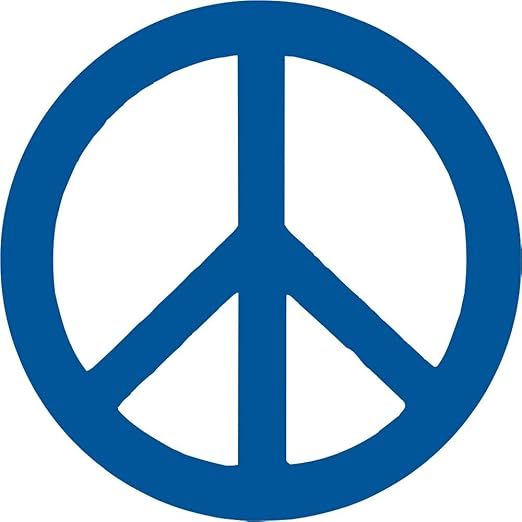
Even the modern day symbol for peace (see symbol above) isn’t without its controversy. Just like we can’t all seem to agree on how to create peace, we can’t even agree on a symbol to represent it. 

The symbol that we all recognize as the peace sign was designed by an English designer Gerald Holtom for the British Campaign for Nuclear Disarmament in 1958.
Holtom based his design on signs from semaphore — a code that involves a signaler positioning two flags to represent letters. Semaphore was used a long time ago in the British navy to communicate over long distances. 
To represent nuclear disarmament, the designer combined the semaphore characters for N (two flags held in an upside-down V) and D (one flag held straight up and one held straight down.) This gave him “N” and “D” — for nuclear disarmament and he enclosed the combination in a circle. 
Noncom said that the symbol also represented despair with its suggestion of a human with its outstretched arms against the back-up of a white Earth. He later regretted this dour interpretation. 

The CND first used the symbol during a march to protest the Atomic Weapons Research Establishment in Aldermaston, England. In the 1960s, activists in Europe and the United States picked it up. It was often used in protests against the Vietnam War, and it came to represent peace in general rather than just nuclear disarmament.
I would guess that the symbol’s popularity had a lot to do with its simplicity — it’s easier to draw three lines in a circle than to draw a flying dove — that was probably the most common peace symbol before Holtom’s. By the end of the 1960s, this peace symbol was entrenched.

But as I said, seems like nothing much is without controversy…. as the symbol gained popularity, critics of the antiwar movement said it was actually an old anti-Christian sign called Nero’s Cross. Supposedly Roman Emperor Nero crucified Saint Peter upside down in A.D. 67 and popularized the symbol — a representation of an inverted, broken cross — to mock Christianity. Some critics also claimed that Satanists used the symbol in the Middle Ages and that Nazis adopted it in the 1930s. Some people still see it primarily as an anti-Christian symbol.

From what I can tell, there have been variations on the design long before 1958. Something very similar can be found in Germanic and Scandinavian runic alphabets — and those date back to A.D. 150.
There doesn’t seem to be any evidence that Holtom had anti-Christian or Nazi connotations in mind when he created the symbol. But he probably should have done a little more research — if you’re trying to promote peace, the last thing you’d want is Nazi implications….
— 30 —

Posted in Uncategorized | 1 Comment

Peace

The news this morning said that President Trump now wants to take over Gaza. Seems like he’s got his sights set on a lot of the world. A separate article indicated that scientists have re-set the “Doomsday Clock” — this time closer than ever to…. well, doomsday.

It certainly appears that the hope for peace is becoming dimmer every day. I’ve mentioned recently that I have American Indian blood and over the years I’ve studied and read a fair amount about their history and heritage. I’m not sure why, but today I thought about something that Black Elk, a Oglala Sioux said — it just strikes me as being appropriate for today’s blog…..

“What is Life? It is the flash of a firefly in the night. It is the breath of a buffalo in the wintertime. It is the little shadow which runs across the grass and loses itself in the sunset. The True Peace. The first peace, which is the most important, is that which comes within the souls of people when they realize their relationship, their oneness, with the universe and all its powers, and when they realize that at the center of the universe dwells Wakan-Taka (the Great Spirit,) and that this center is really everywhere, it is within each of us. This is the real peace, and the others are but reflections of this. The second peace is that which is made between two individuals, and the third is that which is made between two nations. But above all you should understand that there can never be peace between nations until there is known that true peace, which, as I have often said, is within the souls of men.” 
— 30 —

Posted in Uncategorized | Leave a comment

Name Game

The new administration seems to be hung up on changing the names of everything — making it even more difficult for people lie me to know were we are. According to the new boss, the Gulf or Mexico is now the Gulf of America, and he’s designating the tallest peak in North America — standing 20,310 feet — to be labeled Mt. McKinley. 

Not that the new guy cares about history, but for many generations, native people lived around the mountain. Different tribes had a variety of names for it, but they all generally meant the same thing — “the great one” or “the high one.”

The name Mt. Mckinley was given to the mountain by a gold prospector some years ago. Indians have always had the view that commemorative names like Mt. McKinley are inappropriate — humans are too small, too fleeting and insignificant to have places named for them.

Until a few days ago, the peak had been officially renamed Denali during the Obama administration. The name Denali is from Alaska’s Athabaskan people — it translates roughly to “The Great One.”

Changing the name to Mt. McKinley was apparently advocated by politicians, including Republicans from Ohio — McKinley’s home state. Their reasoning was that they wanted to recognize the legacy of a historic national figure. I think the Indians had it right…. humans are too small and insignificant — Denali means The Great One — guess what the next name for that mountain will be — by executive order…….
— 30 —

Posted in Uncategorized | Leave a comment